Return to All Blogs

Logic Programming: Definition, Concepts, Prolog & Uses

Explore logic programming and its applications in modern software development. A step-by-step guide to mastering logic-based coding.


0 mins read
Logic Programming

Imagine describing what you want, not the specific steps for how to do it. That is the core of logic programming, a fundamentally different way to create software. You provide a set of logical rules and facts about a problem area, and the system applies reasoning to find solutions and answer queries. This declarative method is especially suited for complex tasks and stands in sharp contrast to imperative or object-oriented models.

For engineering teams and tech leads, understanding this approach is increasingly important.  Its principles are the foundation for significant advancements in AI-assisted software development, sophisticated database systems, and complex symbolic computation. Integrating its concepts can permit you to build more intelligent and adaptable software. This guide provides the insights your team needs to comprehend its potential. For a deeper primer, see our logic programming guide.

TL;DR: Logic Programming

Logic programming is a declarative paradigm where you state facts and rules, and an inference engine derives answers via unification and backtracking. It excels at knowledge representation, constraint solving, and expert reasoning in AI, databases, and scheduling. (See also: Prolog, Datalog, ASP.)

Key Facts about Logic Programming

  • Paradigm: Declarative; programs = facts + rules (clauses).

  • Inference: Unification + resolution; execution via backtracking (goal-directed / backward chaining). 

  • Languages: Prolog, Datalog, Answer Set Programming (ASP).

  • Strengths: Knowledge representation, constraints, expert reasoning, deductive databases.

  • Limits: Debugging logic, scalability of search space, performance for numeric workloads.

What is Logic Programming?

Logic programming is a paradigm based on formal logic where you state the conditions of a problem and the desired outcome, not the step-by-step procedure to achieve it. In this declarative model, you provide facts (things that are true) and rules (inferences that can be made), and the system uses a logical engine to deduce answers to your queries.

Applications and Use Cases

This approach is highly effective for problems defined by complex rules and relationships. Common applications include expert systems, scheduling, and database management. You’ll often pair it with API design choices or planning components within broader software development workflows.

A clear, real-world application is a product configuration engine, like one on a PC builder website.

  • Goal: Build a gaming PC under $1500.

  • Facts: A database contains components, prices, and performance benchmarks (e.g., component(gpu_A, price_400)).

  • Rules: The system holds compatibility and requirement rules (e.g., requires(game_X, gpu_Y), compatible(cpu_Z, motherboard_W)).

  • Query: The user's request acts as a query. The logic programming system deduces all possible component combinations that satisfy the budget, compatibility, and performance rules without being explicitly programmed for every possible build.

History and Evolution of Logical Programming

The origins of logic programming are in 1960s automated theorem proving, which culminated in the creation of Prolog (Programming in Logic) in the early 1970s by Alain Colmerauer and his team.

Histoy and evolution of Logical Programming

This history is important for developers today because of the renewed focus on Explainable AI (XAI). While deep learning models excel at identifying patterns in vast datasets, they often function as "black boxes," making it difficult to understand their reasoning. Logic programming offers a foundation for symbolic reasoning, where decisions are transparent and auditable because they are based on explicit facts and rules.

This makes it a vital component in modern hybrid systems that combine neural networks with symbolic logic to create more powerful and trustworthy intelligent applications.  For practical angles on integrating model-driven workflows, see how to train an AI model and tooling like local LLM tools.

Core Concepts in Logic Programming

Paradigm

You write

Control flow

Strengths

Weak spots

Typical uses

Logic

Facts & rules; queries

Engine decides (search/backtracking)

Symbolic reasoning, constraints, explainability

Performance on numeric/low-level tasks

Expert systems, CSPs, deductive DBs

Functional

Pure functions

Expression evaluation

Determinism, composition, testability

Stateful workflows

Data transforms, compilers

Imperative/OOP

Steps/commands

Explicit (loops, conditionals)

Performance, control

More boilerplate, weaker explainability

Systems, HPC, apps

The paradigm is built on several foundational ideas that set it apart. Understanding these concepts is essential for any developer looking to add this tool to their technical repertoire.

1) Declarative Programming

Declarative programming is a style where you describe the desired result without explicitly listing the commands or steps that must be performed. This contrasts sharply with imperative programming, where you provide a sequence of commands for the computer to execute.

Think of it as giving a destination versus providing turn-by-turn directions. For instance, when using SQL, you declare the data you want: SELECT name FROM users WHERE country = 'Canada'. You don't write the specific steps to loop through the user table, check each entry, and add the name to a list. The imperative alternative would involve manually writing those loops and conditional checks.

Logic programming is declarative because you define the 'what' (the logic) and let the engine figure out the 'how' (the execution). Your focus shifts from control flow to defining relationships and truths.  If you’re coming from frontend frameworks and want to keep your stack maintainable, our component tests guide and state transition testing guide can help you think in terms of behavior and rules.

2) Rules-Based Systems

A rules-based system is a software model that stores and manipulates knowledge to interpret information in a useful way. These systems are central to how this programming style functions.

Facts are fundamental assertions of truth within a domain. Rules are statements that permit the system to infer new facts from existing ones. By providing a set of facts and rules, you equip the system to make logical deductions and arrive at new conclusions.

Real-World Examples

Fraud Detection

A financial institution might use a rules-based system to flag potentially fraudulent credit card transactions.

  • Facts:

    • transaction(user123, 25000, 'Brazil').

    • user_location(user123, 'India').

    • transaction_history(user123, 'low_international_activity').

  • Rule:

    • A transaction is flagged as suspicious if the transaction amount is over a certain threshold (e.g., ₹20,000), occurs in a foreign country, and the user has a history of low international activity.

    • In logic programming, this might look like: flag_as_fraud(User) :- transaction(User, Amount, Country), user_location(User, HomeCountry), Amount > 20000, Country \= HomeCountry.

Access Control

A system can determine if a user has permission to access a specific file or feature in a software application.

  • Facts:

    • user_role(alice, 'admin').

    • user_role(bob, 'editor').

    • resource_clearance('system_logs', 'admin_only').

    • resource_clearance('blog_posts', 'editor_or_above').

  • Rule:

    • A user can access a resource if their role matches the resource's required clearance.

    • A simplified rule in logic could be: can_access(User, Resource) :- user_role(User, 'admin'), resource_clearance(Resource, 'admin_only').

3) Knowledge Representation

Knowledge representation is the field of artificial intelligence dedicated to representing information about the world. This information is stored in a structure that a computer system can utilize to solve complex tasks.

In this paradigm, knowledge is represented explicitly through facts and rules. This creates a human-readable knowledge base that is separate from the underlying inference engine. This separation makes the system's logic transparent and easier to modify without altering the core codebase architecture. For maintainability practices, see code documentation best practices and code integrity.

4) Constraint Satisfaction

Constraint Satisfaction Problems (CSPs) are mathematical questions defined as a set of objects whose state must satisfy a number of constraints. These are common in scheduling, planning, and resource allocation.

Logic programming is exceptionally well-suited to solve CSPs. You define the variables of your problem and the constraints they must obey. The logic engine then systematically searches for a solution that satisfies all defined constraints, making it a powerful tool for optimization and configuration problems.

For example, a modern frontend build system could use it to resolve dependency versions. Each package has constraints (e.g., react > 18.0, lodash < 4.17), and the system must find a set of versions that satisfies all of them simultaneously.

5) Automated Reasoning

Automated reasoning is a subfield of computer science concerned with building machines that can reason automatically. This reasoning can take the form of deduction, induction, or abduction.

Logic programs are a direct application of automated reasoning. The system's execution is a process of logical deduction. According to the Association for Logic Programming, this capability is fundamental to building systems that can perform complex planning and diagnostic tasks without human intervention. The two main inference mechanisms are:

Forward Chaining

This is a data-driven approach. It begins with the available facts and applies inference rules to generate all possible conclusions. This cycle continues until no new facts can be produced.

  • When to Use: It is most effective when you gather new information and want to determine what new conclusions can be drawn from it. This makes it suitable for monitoring, control, and planning applications where data flows in and requires a response.

  • Example: A Supply Chain Alert System

    • Facts: (Warehouse A inventory < 10 units), (Product X is high-demand)

    • Rule: IF (inventory < threshold) AND (product is high-demand) THEN generate_restock_order()

    • Action: The system starts with the facts about inventory and product demand. It applies the rule and automatically triggers a restock order. The reasoning moves from the initial data to a conclusion/action.

Backward Chaining

This is a goal-driven approach. It starts with a potential conclusion (a goal or hypothesis) and works backward to find facts and rules that support it. This is the primary method utilized by the Prolog programming language.

  • When to Use: It is highly efficient for diagnostic tasks, classification, and question-answering systems where you have a specific goal to validate. It avoids generating irrelevant conclusions.

  • Example: A Medical Diagnostic System

    • Goal: "Does the patient have Strep Throat?"

    • Reasoning: The system works backward. To confirm Strep Throat, it searches for supporting rules and facts.

      1. Does the rule IF (has sore throat) AND (has fever) THEN (may have Strep Throat) apply?

      2. The system then queries for the facts: "Does the patient have a sore throat?" and "Does the patient have a fever?".

      3. If these facts are confirmed in the patient's data, the initial goal is supported. The reasoning starts with a hypothesis and seeks evidence for it.

6) Logic Inference

Logic inference is the process of deriving logical conclusions from premises known or assumed to be true. In logic programs, this is the core computational mechanism.

When you pose a query to a logic program, the inference engine attempts to prove that the query is true based on the facts and rules in the knowledge base. It does this by matching the query against facts or the heads of rules. If it matches a rule, it then tries to prove the conditions in the body of that rule. This recursive process constitutes the program's execution.

Common inference techniques include:

  • Resolution: A rule of inference that produces a new clause by combining two clauses containing complementary literals. It is a complete inference method for first-order logic.

  • Unification: The process of finding substitutions for variables to make two logical expressions identical. This is the mechanism that matches queries with facts and rule heads.

7) Symbolic Computation

Symbolic computation involves the manipulation of mathematical objects as symbolic structures rather than as their numeric values. Because logic programs operate on symbols and structures, they are a natural foundation for Symbolic AI, which reasons with explicit symbols and rules. For adjacent ideas in program structure and tooling, you might enjoy our visual scripting guide.

This approach allows a system to reason about problems abstractly. For instance, a program can process a logical rule like path(A,C)←path(A,B)∧path(B,C) without needing specific values for A, B, and C. This capacity for abstract, structural reasoning is a powerful tool for generalized problem-solving, with applications in several modern and classic domains:

  • Mathematical Solvers: Computational tools like WolframAlpha use symbolic computation to solve complex equations, simplify algebraic expressions, and perform calculus with exact precision.

  • Knowledge Graphs: These systems represent entities and their interconnections symbolically, enabling them to infer new information and answer intricate queries.

  • Classic Applications: The method is also fundamental in compiler construction and natural language processing, where source code or sentences are decomposed into their grammatical parts for analysis.

8) Deductive Databases

A deductive database is a database system that can make logical deductions based on facts and rules stored within it. They extend traditional relational databases with a logical reasoning capability. For teams wiring this into services, read our guides on API request types and dynamic code analysis to keep interfaces and runtime checks tidy.

These databases use a query language based on logic to allow for more expressive queries than standard SQL. For example, you can define recursive rules, like finding all managers (direct and indirect) of an employee, which is complex to do in conventional SQL. They rely on logic programming principles to infer information that is not explicitly stored in the database.

Real-world applications include:

  • Network Analysis: Identifying complex connectivity patterns in a computer network.

  • Financial Auditing: Defining rules to automatically detect fraudulent transaction patterns.

  • Supply Chain Management: Querying for all possible shipping routes between two points.

How Logic Programming Works

To truly grasp this paradigm, you must understand its fundamental components: facts, rules, and the execution strategy that brings them to life. We will look at how these elements work together, with a focus on Prolog as the primary example.

Facts and Rules in Logic Programming

A logic program is constructed from clauses. There are two types of clauses: facts and rules.

  • Facts are statements that are unconditionally true. They are the base data of your program. A fact is a predicate with a specific value, terminated by a period.

    • is_production_ready(feature_branch_A).

    • has_dependency(react_app, 'redux').

  • Rules are statements that define how to derive new information. A rule has a head and a body, connected by the :- operator, which can be read as "if". The head is true if the conditions in the body are true.

    • can_be_deployed(Branch) :- is_production_ready(Branch), passes_ci_cd(Branch).

This rule specifies that a branch can be deployed if it is production-ready and it passes the CI/CD pipeline. The comma , represents a logical AND.

Here is a simple logic program combining facts and rules:

Prolog

% Facts: Define the relationships in our tech stack.
component('frontend').
component('backend').
component('database').

language('frontend', 'javascript').
language('backend', 'python').

connected('frontend', 'backend').
connected('backend', 'database').

% Rule: Define what it means for two components to have a data path.
% A data path exists from X to Y if they are directly connected,
% or if X is connected to some intermediate Z which has a data path to Y.
data_path(X, Y) :- connected(X, Y).
data_path(X, Y) :- connected(X, Z), data_path(Z, Y).

In this program, we have defined components, their programming languages, and their direct connections. The data_path rule is recursive, allowing the system to infer indirect connections.

Prolog: The Quintessential Logic Programming Language

Prolog is the most well-known logic programming language, built directly upon the concepts of facts, rules, and queries. While its syntax differs considerably from other languages, developers with a mindset geared toward formal logic often find it easier to learn.

A Prolog program consists of a knowledge base. You interact with it by asking queries. A query is a question you ask the system to prove. Prolog responds with true (and variable assignments) if it can prove the query, or false if it cannot.

Let's expand on the previous example with Prolog syntax and queries.

Prolog

% Knowledge Base (facts and rules)
language('javascript').
language('python').

framework('javascript', 'react').
framework('javascript', 'vue').
framework('python', 'django').

is_frontend(L) :- framework(L, 'react').
is_frontend(L) :- framework(L, 'vue').

% --- Interaction in a Prolog interpreter ---

% Query 1: Is React a framework for JavaScript?
?- framework('javascript', 'react').
true.

% Query 2: What frameworks are available for JavaScript?
% X is a variable (starts with an uppercase letter).
?- framework('javascript', X).
X = react ;  % Semicolon asks Prolog to find more solutions
X = vue.

% Query 3: Which languages are for the frontend?
?- is_frontend(Lang).
Lang = javascript ;
Lang = javascript.

The unique features of Prolog include its built-in search and pattern-matching capabilities. You do not need to write loops or conditional statements. You define the logical relationships, and Prolog's engine handles the search for a solution.

Execution and Search Strategies

The heart of a logic program is its inference engine. The engine automates the search for solutions based on two core mechanisms: unification and backtracking.

  1. Unification: This is the process Prolog utilizes to match a query with facts or rule heads in the knowledge base. It attempts to find a set of variable assignments that makes the query and the database entry identical. For example, the query framework('javascript', X) unifies with the fact framework('javascript', 'react') by assigning X = 'react'.

  2. Backtracking: When a query fails to be proven, or when you ask for alternative solutions, the engine backtracks. It undoes the last unification and looks for a different path to satisfy the goal. This systematic search is exhaustive. It ensures that if a solution exists, the engine will find it.

Consider the query data_path('frontend', 'database') from our earlier example.

  1. The engine first tries the rule data_path(X, Y) :- connected(X, Y).

  2. It unifies X with 'frontend' and Y with 'database'. It then searches for the fact connected('frontend', 'database').

  3. This fact does not exist, so this path fails. The engine backtracks.

  4. It now tries the second rule: data_path(X, Y) :- connected(X, Z), data_path(Z, Y).

  5. It unifies X with 'frontend' and Y with 'database'. The first goal is connected('frontend', Z).

  6. This unifies with connected('frontend', 'backend'), so Z becomes 'backend'.

  7. The next goal becomes data_path('backend', 'database'). This is a new query.

  8. The engine tries to prove this new query. It successfully matches the first rule, data_path(X, Y) :- connected(X, Y), with the fact connected('backend', 'database').

  9. Since all sub-goals succeeded, the original query data_path('frontend', 'database') is proven true.

This automatic search mechanism is incredibly powerful. It allows you to focus on specifying the problem logic correctly, trusting the engine to find a solution.

Applications of Logic Programming

The unique characteristics of this paradigm make it suitable for specific classes of problems, particularly those requiring symbolic reasoning, knowledge management, and complex rule evaluation. Its applications span several important areas of computer science.

Artificial Intelligence

Artificial intelligence is one of the most natural fits for this paradigm. Early AI research heavily depended on it for knowledge representation and reasoning—the building blocks of intelligent systems.

In AI, you often need to represent complex information and draw conclusions from it. Logic programming provides a formal and structured way to do this. A 2025 report "Artificial Intelligence Index Report" indicated that symbolic reasoning techniques, many derived from logic-based systems, are making a comeback to improve the explainability of machine learning models.

An example AI system is one for medical diagnosis.

  • Facts: symptom(patient1, fever)., symptom(patient1, cough).

  • Rule: has_flu(P) :- symptom(P, fever), symptom(P, cough). A query ?- has_flu(patient1). would allow the system to infer a diagnosis.

Expert Systems

Expert systems are computer programs designed to emulate the decision-making ability of a human expert in a narrow domain. They were one of the first commercially successful applications of AI.

Rules-based logic programming is the core technology behind most expert systems. Knowledge from human experts is captured as a set of facts and rules in a knowledge base. The system's inference engine then applies these rules to new data to arrive at a conclusion or a suggestion.

Applications include:

  • Financial Services: Systems that approve or deny loan applications based on a set of financial rules.

  • Manufacturing: Systems that diagnose equipment failures by reasoning about sensor data.

  • Customer Support: Chatbots that guide users through troubleshooting steps based on predefined rules.

Natural Language Processing (NLP)

Natural language processing involves making computers understand and process human language. Logic programming has been historically significant in this field, especially for parsing and semantic analysis.

Definite Clause Grammars (DCGs) are a feature of Prolog that allows you to write natural language grammars. These grammars are effectively a set of rules that describe the structure of a language. The Prolog engine can then use these rules to parse sentences, breaking them down into their constituent parts (nouns, verbs, etc.) and checking for grammatical correctness.

For example, a simple grammar could be defined as: sentence --> noun_phrase, verb_phrase. noun_phrase --> determiner, noun. This allows a program to analyze and understand the structure of text.

Robotics and Problem Solving

In robotics, a machine must perceive its environment and make decisions to achieve its goals. Logic programming provides tools for planning and decision-making.

A robot's possible actions and the state of its world can be described with facts and rules. A query can then ask the robot to find a sequence of actions to get from a starting state to a goal state. The engine's backtracking mechanism effectively searches through possible action sequences to find a valid plan.

This is useful for:

  • Path Planning: Finding a route for a robot in a complex space while avoiding obstacles.

  • Task Scheduling: Deciding the optimal order of tasks for a manufacturing robot.

  • Automated Verification: Verifying that a robot's control system will not enter an unsafe state.

Challenges and Limitations of Logic Programming

While powerful, this paradigm is not a universal solution. Engineering teams must be aware of its challenges and limitations to make informed decisions about where to apply it in their tech stack. Its declarative nature introduces a different set of trade-offs compared to imperative languages.
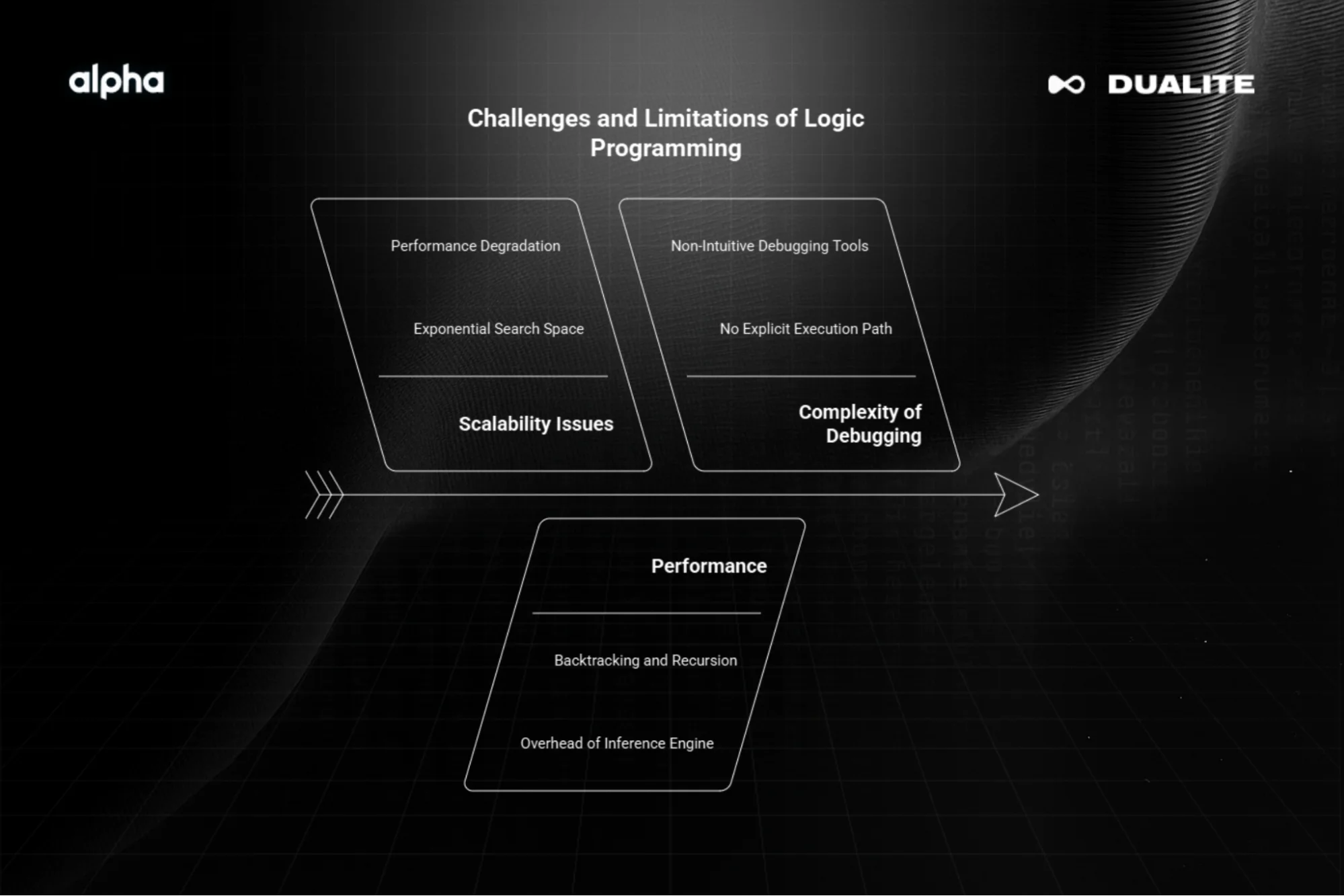
Challenges and Limitations of Logic Programming

1) Scalability Issues

As a knowledge base expands with additional facts and rules, the inference engine's search space can grow significantly. For systems in large domains, a primary consideration is managing this growth to maintain performance. An exhaustive search across a vast number of possibilities can become computationally intensive. Effective scaling involves designing rules that efficiently prune the search space and utilizing optimizations available in modern implementations to guide the inference process.

2) Performance

The automated search mechanisms in logic programming, such as backtracking and recursion, are powerful features. Their efficiency is highly dependent on the structure of the problem being solved. For certain tasks, particularly those involving heavy numerical computation or strictly sequential processes, an imperative implementation in a language like C++ or Rust might be more direct. This makes the architectural choice a matter of matching the problem type to the most suitable programming style.

3) Complexity of Debugging

Identifying issues in logic programs requires a different approach than in imperative programming. The focus shifts from tracing a step-by-step execution to verifying the correctness of the logical statements. A query might produce an unexpected outcome because a rule is formulated incorrectly, a necessary fact is missing, or the logic creates an unintended recursive loop. The process involves analyzing the engine’s reasoning. Specialized tools are available to trace unification and backtracking, and becoming proficient with them is a component of mastering the declarative style.

The Future of Logic Programming

The story of this paradigm is far from over. Instead of being replaced, its concepts are being integrated with other programming models. This fusion is creating new possibilities and addressing some of its long-standing limitations. Research continues to push its boundaries in critical areas of technology.

Integration with Other Paradigms

One of the most exciting developments is the integration of logic programming with other paradigms. This hybrid approach seeks to combine the best of multiple models.

  • Functional Programming: Both functional and logic programming are declarative. Their integration allows for systems that benefit from the strong data transformation capabilities of functional languages and the reasoning power of logic engines.

  • Machine Learning: A significant resurgence is occurring in neuro-symbolic systems, which combine logical reasoning with statistical machine learning. This approach directly confronts the "black box" problem of many deep learning models, aiming to produce systems that are not just predictive but can also explain their reasoning. Prominent research labs are at the forefront of this movement. For instance, IBM Research is developing technologies like Logical Neural Networks, while Google's DeepMind has published significant work on combining deep learning with symbolic structures for improved reasoning. A survey on arXiv in early 2024 confirmed that numerous research teams are actively merging neural networks with logic-based components to build more transparent and capable intelligent systems.

Advances in Logic Programming Research

Active research continues to refine and extend the capabilities of logic-based systems. These advancements are making the technology more powerful and applicable to a wider range of modern software development challenges.

Recent research breakthroughs are concentrated in:

  • Automated Reasoning: New algorithms and optimizations are making inference engines faster and more scalable, allowing them to tackle larger and more complex problems.

  • Answer Set Programming (ASP): A modern variant of logic programming that is particularly effective for solving difficult search and optimization problems. It is gaining traction in areas like bioinformatics and automated planning.

  • Probabilistic Logic Programming: This extension integrates probability with logic, allowing systems to reason under uncertainty. This is crucial for applications in fields where data is inherently noisy or incomplete.

Conclusion

Now that you understand the declarative nature of logic programming, along with its core concepts like rules-based systems and automated reasoning, you have a solid foundation. We have also examined Prolog, its unification and backtracking mechanisms, and its applications in artificial intelligence, expert systems, and natural language processing, while acknowledging its performance and scalability challenges.  To put this into practice, start small and iterate alongside good engineering hygiene: software development workflow, code documentation best practices, and automated code review.

Future trends suggest its fusion with other paradigms, making its principles highly relevant. For developers and engineering teams, learning logic programming is a valuable investment, fostering declarative thinking, separating logic from control, and building intelligent, data-driven systems. Apply these concepts to your AI, database, and problem-solving tasks.

FAQs Section

1) What is the logic of programming? 

Logic programming uses formal logic to express relationships and rules in a program. Computation is performed by applying logical reasoning to deduce results from these statements, making the approach declarative.

2) What is logic programming with an example? 

Logic programming involves creating facts and rules to represent knowledge. For example, in Prolog, you define facts like parent(john, mary). and a rule grandparent(X, Y) :- parent(X, Z), parent(Z, Y).. This lets you infer results.

3) What is logic programming in AI? 

In AI, logic programming is applied for knowledge representation, automated reasoning, and building intelligent systems. Expert systems, for instance, utilize rules and facts to make decisions and provide explanations.

4) What is the basic idea of logic programming? 

The basic idea of logic programming is to represent a program as a set of logical sentences. These sentences consist of facts (assertions of truth) and rules (conditional truths). Computation occurs by asking a query and having the system logically infer the answer.

Overview

Ready to build real products at lightning speed?

Try the AI platform to turn your idea into reality in minutes!

Other Articles

Dualite vs Replit: Which AI App Builder Should You Choose in 2026?

Dualite and Replit are both AI app builders that turn plain-English prompts into deployable apps : but they are built for fundamentally different people. Dualite is a no-code AI app builder for founders, designers, and non-technical users — it ships unlimited messages on the $79/month Launch plan, predictable flat pricing with no surprise overages, dedicated 1-to-1 support, image and Midjourney uploads, 100+ high-quality templates, and full GitHub plus ZIP code access on the free Starter plan. Replit is a developer-first cloud IDE with an AI Agent on top — powerful for engineers comfortable with code editors and terminals, but it uses effort-based credit pricing where users routinely report $100-$300+ monthly bills against a $25 base plan, charges for failed AI operations, and reserves dedicated human support for Enterprise. If you want predictable pricing, real human support, and a workflow built for non-technical founders, Dualite is the better fit. If you are an experienced developer who wants a full cloud IDE with an AI agent and you can budget for unpredictable credit consumption, Replit can work.

Why compare Dualite and Replit?

Both Dualite and Replit sit in the broad AI app builder category : both turn natural-language prompts into deployable code, both have substantial user bases, and both let you go from idea to live URL without leaving the platform.

But the two platforms are solving fundamentally different problems for fundamentally different users. Replit is a full cloud IDE first — with a code editor, terminal, file tree, and deployment configuration — with the Agent layered on top. It is built for developers who want AI assistance inside an environment they already understand. Dualite is built the other way around : a prompt-and-preview interface where the code is the output, not the workspace, designed for founders and designers who want a finished product without learning the IDE.

That difference shows up in pricing, support, predictability, and how much technical comfort you need to bring. This guide breaks down where Dualite and Replit differ on the things that actually matter when you are shipping a real product.

Dualite vs Replit: Quick comparison at a glance

Here is the side-by-side breakdown across the features that decide which tool actually fits your workflow:

  • Free plan limits : Dualite gives you 5 messages with full feature access on the Starter plan and no Dualite badge on your output. Replit's Starter plan gives you free daily Agent credits, 1 published app, public projects only, and a "Made with Replit" badge that requires a paid plan to remove

  • Pricing model : Dualite uses simple message-based pricing: 5 free messages, 200 messages on Pro at $29/month, unlimited on Launch at $79/month. Replit uses effort-based credit pricing where every Agent action burns a variable amount of credits based on "effort" (time and computation), and Replit explicitly states "simple tasks may cost less than $0.25, more complex tasks may cost more than $0.25"

  • Unlimited plan : Dualite's Launch plan at $79/month is fully unlimited with no message caps. Replit has no unlimited tier at any price point Core at $20/month gives $20 in monthly credits that do not roll over, and Pro at $100/month gives $100 in credits with one-month rollover

  • Pricing predictability : Dualite's monthly bill is exactly what is on the plan page. Replit's pricing is well-documented as volatile : community reports of bills ranging from $100 to $300 against a $25 plan are common, and accounts have no spending caps by default unless manually configured

  • 1-to-1 customer support : Dualite's Launch plan includes dedicated 1-to-1 support with a product expert you can speak to anytime. Replit's Core plan offers community support only; Pro at $100/month gets "priority support" with under-24-hour responses on business days; dedicated support and SLAs are reserved for Enterprise (custom pricing)

  • Who it is built for : Dualite is built for non-technical founders, designers, and entrepreneurs who want a finished product. Replit is built for developers who want a cloud IDE with an AI agent inside it the workspace assumes you can read code, work with a terminal, and configure deployments

  • Image and Midjourney uploads : Dualite has first-class, documented support for attaching images, videos, and Midjourney outputs to guide the build, available on every plan. Replit supports image uploads in Agent chat as references, but the workflow is more developer-leaning

  • Design templates : Dualite ships 100+ high-quality, fully branded templates across e-commerce, dashboards, AI apps, mobile apps, portfolios, and games. Replit's templates are more developer-focused starter codebases (boilerplates, language starters, framework templates) rather than fully designed product templates

  • Charging for failed operations : Dualite charges per message regardless of whether you accept the result or revert. Replit charges for AI operations even when they fail, hang, or error out, per checkpoint well-documented in user billing reports

  • Partner Program : Dualite has a dedicated expert build service for founders stuck at 60-80% of their product. Replit has no equivalent managed handoff program : if you get stuck, you hire a developer or post in the community forum

How do Dualite and Replit compare on pricing?

This is where the two platforms diverge the most not just in numbers, but in how predictable your monthly bill actually is.

Dualite uses message-based pricing. A message is any instruction you send : the first prompt, a layout tweak, a feature addition. Every interaction counts as one message, regardless of complexity. The Starter plan gives 5 free messages, Pro gives 200 messages for $29/month, and Launch gives unlimited messages for $79/month. Annual billing saves up to 20%. The plan price is the bill. There are no overages, no "effort" multipliers, no surprises.

Replit uses effort-based credit pricing. Every Agent action consumes a variable amount of credits depending on "effort" measured in time and computation. Replit's own pricing documentation states this directly: "simple tasks may cost less than $0.25, more complex tasks may cost more than $0.25." The Free Starter plan gives limited daily credits and 1 published app. Core is $20/month and includes $20 in credits. Pro is $100/month with $100 in credits. Enterprise is custom. None of these tiers is unlimited, and credits expire monthly on Core (Pro gets one-month rollover).

The practical difference is enormous. With Dualite Launch, your monthly cost is $79. With Replit, your $25 plan can become a $200+ bill on a heavy build month community reports of $100-$300 monthly bills against a $25 plan are well-documented. Replit accounts also have no spending caps by default; you have to manually configure cost controls to avoid runaway bills.

Why does pricing predictability matter?

Effort-based pricing creates a specific problem: you cannot budget for it.

A simple feature might cost $0.25 in credits. A complex feature with a long debugging loop might cost $5. Multiple back-and-forth corrections on a stubborn bug can cost $20 or more for what feels like a single task. And because Replit charges for failed operations — yes, even when the AI hangs, errors out, or simply does nothing — unsuccessful attempts still consume your credit balance.

Dualite's flat pricing removes that uncertainty entirely. Build stress-free. Iterate as many times as you want. Try ten variations of the same screen if that is what your product needs. The whole reason to use an AI builder is speed — a credit meter that punishes complexity, debugging, and iteration defeats the point. And on Launch, every message is unlimited anyway.

This is especially valuable for:

  • Solo founders shipping an MVP and validating it through 10 to 20 design iterations

  • Agencies running multiple client projects in parallel with predictable monthly costs

  • Teams building production-grade apps where edge cases require dozens of follow-up prompts

  • Anyone who has been burned by an unexpected $200 bill on what was supposed to be a $25 plan

Who is each platform actually built for?

This is the second-biggest difference between Dualite and Replit and the one most users miss before signing up.

Dualite is built for non-technical founders and designers. The workspace is a prompt-and-preview interface : you describe what you want, you see it built, you click on elements to refine them in plain English, and you publish. The code is the output, not the workspace. You do not need to read it, edit it, or understand it to ship a working product. Interaction Mode lets you click any element and instruct the AI in natural language. Fix with AI handles errors automatically. The whole experience is designed so that someone who has never opened a code editor can ship a complete app.

Replit is built for developers. The workspace is a full cloud IDE a code editor on the left, file tree, terminal, deployment configurations, environment variables, and the Agent panel. The Agent is excellent at autonomous coding (Replit's Agent 3 can run for hours on complex tasks), but the surrounding environment assumes you can read the code it writes, work with a terminal when something goes wrong, and understand concepts like compute units, autoscale deployments, reserved VMs, and CIDR-block configurations. Replit's documentation, community, and product are all written for technical users.

This is not a knock on Replit it is a deliberate product choice, and Replit is genuinely strong for the developers it serves. But for a non-technical founder, the IDE itself becomes a barrier. You are not just learning to use an AI builder; you are learning to use a development environment.

What does customer support look like on each platform?

When you are stuck at midnight on a launch deadline, the difference between "talk to a human now" and "submit a ticket and wait" is enormous.

Dualite Launch includes dedicated 1-to-1 support. You get a real product expert not a chatbot, not a queue who knows the platform inside out and can help you unblock specific build issues, optimise prompts, or restructure complex projects. Pro plan users get priority email and Discord support with 2-hour response times.

Replit's support is tiered toward Enterprise. The free Starter plan gets community support only the Replit Discourse forum. Core at $20/month gives community support and standard email response times. Pro at $100/month upgrades you to "priority support" with under-24-hour responses on business days. Guaranteed customer support SLAs and dedicated account managers are reserved for Enterprise (custom pricing, sales call required).

If you are non-technical and learning as you build, having a human you can actually talk to is the difference between shipping in a week and giving up after two days. Replit's structure assumes you have the technical skills to debug your own problems and lean on the developer community when you need help.

How does pricing volatility show up in real bills?

Effort-based pricing sounds reasonable in theory : pay for what you use. In practice, it makes monthly costs hard to predict and easy to overrun.

Documented user reports tell the story:

  • One Replit user reported 632 Agent checkpoints in a single billing period at $0.25 each, totaling $158, plus 965 Assistant checkpoints at $0.05 each, adding another $48 — over $206 in checkpoint charges alone, on top of the base subscription

  • Charges for failed operations are well-documented — Replit users are billed per checkpoint regardless of whether the AI succeeded, hung mid-execution, or errored out

  • Once monthly credits are depleted, subsequent actions are billed directly to the payment method on file without prior notice unless the user has manually configured spending caps

  • Replit users on the Core plan have reported monthly bills of $100-$300 for what they expected to be a $25/month subscription

Dualite has none of this. Pro is $29/month for 200 messages. Launch is $79/month unlimited. There are no per-prompt charges, no "effort" multipliers, no overages, no charges for failed actions. The bill on the first of the month is exactly what is on the pricing page.

Can you upload images on Dualite and Replit?

Yes on Dualite, with first-class support. Dualite has dedicated documentation for attaching images, videos, and Midjourney outputs to your prompts. You can upload a screenshot of a UI you want to copy, a reference design, a logo, or even Midjourney-generated images and videos to guide the build. Image uploads work across all plans including the free Starter tier, and the workflow is built for visual-first thinkers.

Yes on Replit, but the workflow is developer-leaning. Replit Agent supports image attachments in chat as references for code generation, and you can paste Figma URLs into the Agent for design context. The Figma import flow works, but it is gated by Figma's own seat-type limits (free Figma users get 1 import per month). The workflow assumes you understand the code that will be generated from the image.

For designers, founders with mood boards, and anyone whose product idea is visual-first, Dualite's image and Midjourney workflow gives you a smoother path from inspiration to working app.

How do the design templates compare?

Templates are how non-designers ship something that looks professional. The quality and breadth of the template library directly affect how good your finished product looks.

Dualite ships 100+ high-quality templates built by the Dualite team and community contributors, across e-commerce (Lorvique, SOHO, Modern Sneaker Website, Norden, Potential Coffee), business and agency sites (Yellow Studio, Jane AI, Straton AI, Converge), restaurants (Horai), wellness (Soothemi), interiors (Claymist), real estate (1-Reserve), portfolios (Jenny Hu, Interactive Designer), banking dashboards (Nova), AI apps (AI Voice Receptionist, AI Fashion Studio, Van Gogh Styler, Memory Lane, Playful Typewriter), mobile apps (Cleer Finance, Investify), and games (Super Mario, FigJam-style flowchart builder). Every template is fully branded and free.

Replit's templates are developer-focused. The Replit Templates gallery is rich, but it leans toward starter codebases : language starters (Python, Node.js, Go), framework boilerplates (Next.js, Flask, FastAPI), and basic app skeletons. They are excellent if you are a developer looking for a working starter project. They are not finished, branded product templates the way Dualite's library is.

If your product needs to look impressive from the first screen as a complete branded experience, Dualite's library gives you a stronger starting point. If you want a clean Python or Next.js boilerplate to extend, Replit's templates work well.

Does Replit charge for failed AI operations?

Yes — and this is one of the most-discussed pain points in the Replit user community.

Replit's effort-based pricing model charges per checkpoint based on the AI's work. Critically, this charge applies regardless of whether the operation succeeded. Documented user reports confirm that:

  • Charges accumulate when AI operations did nothing useful

  • Charges apply when AI operations hung mid-execution and had to be killed

  • Charges apply when AI operations errored out and produced no usable result

  • All usage-based charges are non-refundable, even within the documented 30-day evaluation period

Dualite charges per message regardless of acceptance, but each message is a flat unit. A complex prompt that triggers heavy AI work counts as one message, the same as a simple prompt. There is no "effort multiplier" that bills you more when the AI struggles. And on Launch, every message is unlimited anyway — so failed attempts cost you nothing extra.

What if you get stuck at 80%? Dualite's Partner Program

Most AI builders leave you on your own when prompts stop working. Dualite has a dedicated solution: the Partner Program.

If you have built 60-80% of your product using Dualite but cannot finish the last stretch — maybe you need a complex backend integration, a specialised API hookup, or custom logic that prompts cannot describe — Dualite's expert team picks up where you left off and delivers a finished, deployed product, typically in days rather than months. It is a structured, managed service from the team that built the platform.

Replit has no equivalent. If you get stuck on Replit, your options are: post in the Replit Discourse community forum, hire a freelance developer to take over the project, or burn more credits trying to debug it yourself. There is no managed expert-handoff program from the Replit team. The Partner Program is a real differentiator for non-technical founders who care more about shipping than about doing every step themselves.

Which AI models power each platform?

Dualite uses three leading models across all plans : OpenAI GPT 5.1, Claude Sonnet 4.5 by Anthropic, and Google Gemini 3 Pro. Free Starter users get the same AI quality as Launch users — the only difference between plans is message count and support level. Dualite picks the best model for each task automatically, or you can specify your preference.

Replit Agent uses multiple models behind the scenes, primarily Claude Sonnet 4 with Replit's own orchestration layer (Agent 3) on top. Replit also offers different "modes" : Economy Mode and Power Mode on all plans, with Turbo Mode reserved for Pro and Enterprise. Higher-quality modes consume credits faster, so you pay for output quality through the credit system.

Across all three of Dualite's models, you get the same code generation quality whether you are on the free plan or paying $79/month. With Replit, even on a paid plan, switching to a higher-quality mode means burning through credits faster.

What about visual editing and click-to-edit?

Both platforms have a way to edit specific elements without describing them in words — but the workflows are different.

Dualite's Interaction Mode. Click directly on any element in the live preview — a button, a card, a heading — type your change in plain English, and Dualite captures the element's exact technical metadata before applying the fix. No describing where the element is. No telling the AI which div to target. Just click and instruct. Built for non-technical users.

Replit's Visual Editor and Design Mode. Replit has a Visual Editor that lets you make UI tweaks inline, with controls for properties like padding, text color, and background color. Design Mode is more focused : you can convert a Design Mode project to a full application with a single click. The Visual Editor is genuinely useful for small style changes, but it is closer to "edit the generated code visually" than "click any element and tell the AI what to do in plain English."

For non-technical users, Dualite's Interaction Mode is significantly more intuitive. For developers comfortable with the IDE, Replit's Visual Editor is a productive addition to the workflow.

Which platform should you choose?

Here is a simple decision framework:

  • Choose Dualite if you want predictable flat pricing with no overages, need real 1-to-1 human support, are non-technical or design-focused, want a workspace built around prompts and preview rather than a full IDE, care about high-quality branded design templates, and need image and Midjourney workflows for visual-first building. Best for founders shipping real products, designers, agencies, and anyone who wants to focus on the product rather than on managing a credit budget

  • Choose Replit if you are an experienced developer who wants a full cloud IDE with an autonomous AI agent on top, are comfortable budgeting for unpredictable monthly costs, can configure spending caps and review credit usage, and want access to a code editor, terminal, and deployment configuration alongside the AI. Reasonable for developers who want AI assistance inside a familiar IDE environment

For most builders especially non-technical founders, designers, agencies, and anyone who values predictable monthly bills and human support Dualite's combination of unlimited messages, flat pricing with no surprises, dedicated 1-to-1 support, image and Midjourney workflows, 100+ premium templates, full free-plan feature access, and the Partner Program safety net is the more practical choice. Replit is a powerful developer tool, but it is built for developers — not for founders who want to ship a product without becoming engineers.

Frequently asked questions

Is Dualite cheaper than Replit?

It depends on how you measure it. Dualite Pro at $29/month gives you 200 messages — enough for a full MVP build cycle. Replit Core at $20/month sounds cheaper, but the $20 in monthly credits is consumed by Agent actions at variable "effort" rates, and users routinely report bills of $100-$300 against the $25 plan once heavy Agent usage kicks in. For unlimited usage, Dualite Launch is $79/month with no caps. Replit has no unlimited tier at any price point, and even Pro at $100/month is still credit-metered.

Does Dualite have a free plan like Replit?

Yes. Dualite's Starter plan is free with 5 messages and full access to every core feature 100+ templates, native mobile app builds, Figma import, GitHub import, ZIP download, image uploads, custom domain, backend database, Variables for storing API keys, and all three AI models. No credit card required, no Dualite branding on your output. Replit's Starter plan gives free daily Agent credits, 1 published app, public projects only, and a "Made with Replit" badge that requires a paid plan to remove.

Why are Replit bills so unpredictable?

Replit uses effort-based credit pricing : every Agent action costs a variable amount based on time and computation, with Replit explicitly noting that complex tasks may cost more than $0.25 per checkpoint. Replit also charges for failed AI operations, so unsuccessful attempts still consume credits. And accounts have no spending caps by default — once monthly credits are exhausted, the platform switches to pay-as-you-go billing automatically. Dualite's flat message-based pricing has none of these dynamics : the plan price is the bill.

Can I switch from Replit to Dualite?

Yes. Push your Replit project to GitHub from the Replit dashboard, then import the GitHub repository directly into Dualite using the GitHub import feature. You keep your existing code and continue building on top of it with prompts no rebuild required.

Does Replit have an unlimited plan?

No. Replit's pricing is entirely credit-based. Free Starter gives daily credits, Core at $20/month includes $20 in credits, Pro at $100/month includes $100 in credits with one-month rollover, and Enterprise is custom but none of these are truly unlimited. Once you exhaust your credits, you pay per use. Dualite's Launch plan at $79/month is the only fully unlimited tier in this comparison.

Which platform has better customer support?

Dualite. The Launch plan includes dedicated 1-to-1 support with a product expert not a ticket queue, not a chatbot. Pro plan users get priority email and Discord support with 2-hour response times. Replit's free and Core users get community support; Pro at $100/month gets "priority support" with under-24-hour responses on business days; dedicated SLAs and account managers are reserved for Enterprise (custom pricing, sales call required).

Which is better for non-technical founders?

Dualite, by a significant margin. Dualite is built specifically for non-technical users the workspace is a prompt-and-preview interface, Interaction Mode lets you click on elements instead of describing them, Fix with AI handles errors automatically, the Partner Program provides expert handoff if you get stuck, and 1-to-1 support means you have a human to talk to. Replit is a full cloud IDE with an AI agent inside it powerful for developers, but the workspace itself (code editor, terminal, deployment configurations) assumes you are technical.

Does Replit charge me for failed AI operations?

Yes. Replit's effort-based pricing charges per checkpoint based on the AI's work, regardless of whether the operation succeeded, hung mid-execution, or errored out. This is well-documented in user billing reports. Dualite charges per message but treats each message as a flat unit there is no "effort multiplier" that bills you more when the AI struggles, and on Launch every message is unlimited anyway.

Which platform owns my code?

You do, on both. Both Dualite and Replit let you take your full codebase out of the platform. Dualite includes a one-click ZIP download on every plan including the free Starter. Replit lets you push to GitHub or download files, with full ownership of the generated code. The portability difference is mostly about ease : Dualite's ZIP-on-free-plan is more frictionless than Replit's GitHub-first export workflow.

Ready to build without burning credits?

Sign up for Dualite's free Starter plan and ship your first project in under two minutes. No credit card. 5 free messages. Full access to 100+ templates, native mobile app builds, Figma import, GitHub import, image uploads, and all three AI models from day one.

Comparisons

Arnav Uniyal

Dualite vs V0 by Vercel: Which AI App Builder Should You Choose in 2026?

Dualite and v0 by Vercel both turn plain-English prompts into code, but they are built for very different people. Dualite is a full-stack, no-code AI app builder for founders, designers, and non-technical users — it ships unlimited messages on the $79/month Launch plan, builds web and mobile apps natively, includes 1-to-1 dedicated support, image and Midjourney uploads, 100+ templates, and full GitHub plus ZIP code access on the free Starter plan. v0 is a frontend-only UI generator built for React and Next.js developers in the Vercel ecosystem — it generates polished web components and pages, charges by token-based credits with no unlimited tier, has no native backend, no native mobile, no dedicated 1-to-1 support, and locks deployment into Vercel's infrastructure. If you want to ship a complete product end-to-end, Dualite is the better fit. If you are already a frontend developer who just needs beautiful React components for an existing Next.js codebase, v0 has its place.

Why compare Dualite and v0 by Vercel?

Both Dualite and v0 sit in the AI builder category, both turn natural-language prompts into deployable code, and both have meaningful traction — v0 alone supports over 6 million developers, and Dualite has 100k+ users across 150+ countries.

But the two platforms are solving fundamentally different problems. v0 is positioned as an AI pair programmer for frontend developers building inside the Vercel and Next.js ecosystem. Dualite is positioned as a complete app and website builder for non-technical founders who want a finished product, not just UI components.

That difference shows up in pricing, support, what you can actually build, and how much code or context you need to bring yourself. This guide breaks down where Dualite and v0 differ on the things that actually matter when you are shipping a real product.

Dualite vs v0: Quick comparison at a glance

Here is the side-by-side breakdown across the features that decide which tool actually fits your workflow:

  • Free plan limits — Dualite gives you 5 messages with full feature access on the Starter plan and no Dualite badge on your output. v0's free plan gives you $5 in monthly credits which can be exhausted in a single complex session, plus a v0 logo on your output that costs extra to remove

  • Unlimited plan — Dualite's Launch plan at $79/month is fully unlimited with no message caps. v0 has no unlimited tier at any price point — Premium at $20/month gives $20 in credits, Team at $30/user/month gives $30 per user, and Business at $100/user/month gives $30 per user with extra controls

  • 1-to-1 customer support — Dualite's Launch plan includes dedicated 1-to-1 support with a product expert you can speak to anytime. v0 reserves dedicated support and SLAs for the Enterprise plan only (custom pricing, sales call required); paid plans below that get standard email support

  • Mobile apps — Dualite natively builds iOS and Android mobile apps and ships dedicated mobile templates. v0 outputs web code only (React + Tailwind running in a browser); building a real mobile app means exporting the code and wrapping it in a WebView or rebuilding it in React Native yourself

  • Backend and full-stack — Dualite generates frontend, backend, database, and authentication in one workflow. v0 is frontend-only by design — it does not generate backend logic, databases, or authentication; you have to bring those yourself

  • Image uploads — Dualite has first-class, documented support for attaching images, videos, and Midjourney outputs. v0 supports image input, but the Figma import path has been frequently buggy per community reports (designs uploading as flat PNGs instead of editable layers)

  • Design templates — Dualite ships 100+ high-quality templates across e-commerce, dashboards, AI apps, mobile apps, portfolios, and games. v0 has "Blocks" and quick-start templates but does not market a specific count

  • GitHub integration — Dualite includes GitHub import on the free Starter plan. v0 supports GitHub sync on free, but full bidirectional Git integration was only added in February 2026

  • ZIP code download — Dualite includes full codebase ZIP download on the free Starter plan. v0's primary export path is GitHub-first and one-click deploy to Vercel

  • Deployment lock-in — Dualite lets you deploy to any host (Netlify integration is built in, ZIP download lets you take the code anywhere). v0's one-click deploy is to Vercel's infrastructure only

  • AI models — Dualite uses OpenAI GPT 5.1, Claude Sonnet 4.5, and Gemini 3 Pro across all plans. v0 uses three Vercel-fine-tuned proprietary models (Mini, Pro, Max), all priced differently per token

  • Partner Program — Dualite has a dedicated expert build service for founders stuck at 60-80% of their product. v0 has no equivalent

How do Dualite and v0 compare on pricing?

This is one of the most important differences between the two platforms.

Dualite uses message-based pricing. A message is any instruction you send — the first prompt, a layout tweak, a feature addition. Every interaction counts as one message, regardless of complexity. The Starter plan gives 5 free messages, Pro gives 200 messages for $29/month, and Launch gives unlimited messages for $79/month. Annual billing saves up to 20% across paid plans.

v0 uses token-based credit pricing. Every prompt, every iteration, every API call burns credits based on input and output tokens, with three different model tiers (Mini, Pro, Max) at different rates. The Free plan gives $5 in monthly credits which can be exhausted in a single complex session using the Pro or Max model. Premium is $20/month for $20 in credits, Team is $30/user/month for $30 per user, Business is $100/user/month with the same $30 credit per user (the extra cost goes to security and team controls). There is no unlimited tier. Credits do not roll over.

The practical difference: with Dualite Launch, you build, iterate, break, and rebuild without ever hitting a wall. With v0, even Premium users routinely run out of credits mid-project on complex generations and have to top up.

Why does the unlimited plan matter?

Token-based pricing creates a specific problem: you start optimising prompts to save tokens instead of focusing on building the best product.

You batch instructions you would rather send separately. You hesitate before letting the AI auto-fix an error because every retry has a price tag. You skip the third design iteration because you cannot afford the credits. v0's own community reports users blowing through €4 worth of credits on a single buggy Figma import.

Dualite's Launch plan removes that pressure entirely. Build stress-free. Iterate as many times as you want. Try ten variations of the same screen if that is what your product needs. The whole reason to use an AI builder is speed — a credit meter that punishes iteration defeats the point.

Can you build complete apps on each platform?

This is the second biggest functional gap between Dualite and v0.

Dualite generates complete, full-stack applications. Frontend, backend, database, authentication, custom domain, deployment — all in one workflow, all from the same prompts. You describe a finance dashboard, Dualite builds the UI, sets up the backend logic, configures the database, adds login, and gives you a deployed live URL.

v0 is frontend-only by design. It generates polished React components and pages using Next.js, Tailwind, and shadcn/ui — but it does not generate backend logic, databases, or authentication. v0 is explicit about this in its own documentation and community: it is a UI generator, not an app builder. To turn a v0 component into a working product, you have to bring your own backend (Supabase, Neon, your own API), wire up authentication yourself, and stitch the pieces together as a developer.

For founders, designers, and non-technical builders, that gap is the difference between shipping a product and ending up with a folder of unconnected components.

Can you build mobile apps on each platform?

Dualite natively builds mobile apps. From the dashboard, you select Mobile App as your project type and Dualite generates iOS and Android compatible code from the start. Dedicated mobile templates like Cleer Finance and Investify are available out of the box. You go from prompt to a real mobile app inside the same workflow.

v0 outputs web code only. It generates React DOM components (HTML, CSS, JavaScript) that run in a browser — not React Native code that compiles to a native mobile binary. To turn a v0 project into an actual mobile app, you have to either wrap it in a WebView (which Apple frequently rejects under Guideline 4.2 for not feeling native) or rebuild the entire UI layer in React Native yourself. Vercel's own engineering blog admits they did not share UI or state management code between the v0 web app and the v0 iOS app — because web React and React Native are fundamentally different.

If you need to be in the App Store or Google Play, Dualite is built for that. v0 is not.

What does customer support look like on each platform?

When you are stuck at midnight on a launch deadline, the difference between "talk to a human now" and "submit a ticket and wait" is enormous.

Dualite Launch includes dedicated 1-to-1 support. You get a real product expert — not a chatbot, not a queue — who knows the platform inside out and can help you unblock specific build issues, optimise prompts, or restructure complex projects. Pro plan users get priority email and Discord support with 2-hour response times.

v0 reserves dedicated support for Enterprise. Premium, Team, and Business users get standard email support. Guaranteed customer support SLAs, priority access, and dedicated account managers are Enterprise-only features (custom pricing, contact sales). For most solo developers and small teams, that means the same support tier whether you pay $20/month or $100/user/month.

If you are non-technical and learning as you build, having a human you can actually talk to is the difference between shipping in a week and giving up after two days.

Are you locked into a specific deployment platform?

This is a real architectural difference that affects long-term flexibility.

Dualite is deployment-agnostic. Built-in Netlify integration handles one-click deployment, but the ZIP code download option means you can take your codebase anywhere — Vercel, AWS, Cloudflare Pages, your own server, any host. You own the code, you choose the host.

v0 is built for the Vercel ecosystem. One-click deploy goes to Vercel only. While the generated code is portable React/Next.js, the deployment workflow, environment variable management, GitHub sync, and preview URLs are all designed around Vercel infrastructure. You can host v0-generated code elsewhere, but you lose most of the value of the integration.

If you are already on Vercel and plan to stay there, this is fine. If you want optionality, Dualite gives it to you for free.

Can you upload images on Dualite and v0?

Yes on Dualite, with first-class support. Dualite has dedicated documentation for attaching images and videos to your prompts — you can upload a screenshot of a UI you want to copy, a reference design, a logo, or even Midjourney-generated images and videos to guide the build. Image uploads work across all plans including the free Starter tier.

Yes on v0, but the Figma path has been buggy. v0 supports image upload as input. Figma import is available on Premium and above, but the Vercel community has been documenting persistent issues with the Figma integration — designs frequently upload as flat PNGs instead of editable layered files, even for Premium users. That defeats the point of the import and silently burns credits while you debug.

How do the design templates compare?

Templates are how non-designers ship something that looks professional. The quality and breadth of the template library directly affect how good your finished product looks.

Dualite ships 100+ high-quality templates built by the Dualite team and community contributors, across e-commerce (Lorvique, SOHO, Modern Sneaker Website, Norden, Potential Coffee), business and agency sites (Yellow Studio, Jane AI, Straton AI, Converge), restaurants (Horai), wellness (Soothemi), interiors (Claymist), real estate (1-Reserve), portfolios (Jenny Hu, Interactive Designer), banking dashboards (Nova), AI apps (AI Voice Receptionist, AI Fashion Studio, Van Gogh Styler, Memory Lane, Playful Typewriter), mobile apps (Cleer Finance, Investify), and games (Super Mario, FigJam-style flowchart builder). Every template is free.

v0 has Blocks and quick-start templates built around shadcn/ui components — authentication blocks, dashboard layouts, pricing pages, and similar developer-focused starting points. The library is solid and consistent, but it is component-first and developer-leaning, not finished branded product templates.

If your product needs to look impressive from the first screen as a complete branded experience, Dualite's library gives you a stronger starting point. If you want clean, accessibility-checked component primitives to drop into an existing codebase, v0's Blocks are excellent.

What if you get stuck at 80%? Dualite's Partner Program

Most AI builders leave you on your own when prompts stop working. Dualite has a dedicated solution: the Partner Program.

If you have built 60-80% of your product using Dualite but cannot finish the last stretch — maybe you need a complex backend integration, a specialised API hookup, or custom logic that prompts cannot describe — Dualite's expert team picks up where you left off and delivers a finished, deployed product, typically in days rather than months.

v0 has no equivalent. If you get stuck on v0, your options are: hire a developer, learn React deeper, or move to a different tool. The Partner Program is a real safety net for founders who care more about shipping than about doing every step themselves.

Which AI models power each platform?

Dualite uses three leading models across all plans — OpenAI GPT 5.1, Claude Sonnet 4.5 by Anthropic, and Google Gemini 3 Pro. Free Starter users get the same AI quality as Launch users.

v0 uses three Vercel-fine-tuned proprietary models — v0 Mini, v0 Pro, and v0 Max. Each tier has different token costs, with Max being the most expensive and most capable. The models are tuned specifically for React and Next.js code generation, which is why v0's frontend output quality is genuinely strong — but the trade-off is you cannot pick a different model for tasks where another foundation model might do better.

If you care about model choice and transparency, Dualite gives you both. If you just want polished React output and trust Vercel's tuning, v0's models are good at what they do.

Which platform should you choose?

Here is a simple decision framework:

  • Choose Dualite if you want unlimited builds without a credit meter, need full-stack apps (frontend + backend + database + auth), need to build mobile apps, need real 1-to-1 support, are non-technical, want deployment optionality, and care about getting a finished product rather than components. Best for founders, designers, agencies, and anyone shipping real products

  • Choose v0 by Vercel if you are an experienced React or Next.js developer who already has a backend, deploys to Vercel anyway, just needs polished frontend components or pages dropped into an existing codebase, and is comfortable managing a credit budget. Reasonable for senior frontend engineers and Vercel-native teams

For most builders — especially anyone non-technical, anyone shipping mobile apps, anyone who needs a backend, and anyone who values being able to talk to a human when things break — Dualite's combination of unlimited messages, dedicated support, native mobile builds, full-stack generation, image and Midjourney workflows, 100+ premium templates, and full free-plan feature access is the more practical choice.

Frequently asked questions

Is Dualite cheaper than v0 by Vercel?

It depends on what you are building. Dualite Pro at $29/month gives you 200 messages — roughly equivalent to a full MVP build cycle. v0 Premium at $20/month gives you $20 worth of credits, which sounds cheaper until you realise complex generations using v0 Pro or Max can exhaust that in one session. For unlimited usage, Dualite Launch is $79/month with no caps. v0 has no unlimited tier at any price point — even the $100/user/month Business plan is still capped at $30 of credits per user.

Does Dualite have a free plan like v0?

Yes. Dualite's Starter plan is free with 5 messages and full access to every core feature — 100+ templates, native mobile app builds, Figma import, GitHub import, ZIP download, image uploads, custom domain, backend database, Variables for storing API keys, and all three AI models. No credit card required, no Dualite branding on your output. v0's free plan gives $5 of credits, includes a v0 logo on output, and removing the logo is a paid feature.

Can I build a mobile app with v0 by Vercel?

Not natively. v0 generates React DOM code that runs in a browser. To turn a v0 project into a real mobile app, you have to either wrap it in a WebView (which Apple often rejects) or rebuild the UI layer in React Native yourself. Dualite builds iOS and Android compatible apps natively from the dashboard with no rebuild required.

Can I build a backend with v0 by Vercel?

No. v0 is frontend-only by design — it generates UI components and pages but does not generate backend logic, databases, or authentication. You bring your own backend (Supabase, Neon, your own API). Dualite generates frontend, backend, database, and authentication in one workflow.

Can I switch from v0 to Dualite?

Yes. Push your v0 project to GitHub from the v0 dashboard, then import the GitHub repository directly into Dualite using the GitHub import feature on the dashboard. You keep your existing UI code and continue building on top of it with prompts — and Dualite can add the backend, authentication, and mobile build paths that v0 does not generate.

Does v0 have an unlimited plan?

No. v0's pricing is entirely token-based. Free gives $5 in credits, Premium gives $20, Team gives $30 per user, and Business gives $30 per user with extra security controls — but none of these are unlimited. Credits do not roll over either. Dualite's Launch plan at $79/month is the only fully unlimited tier in this comparison.

Which platform has better customer support?

Dualite. The Launch plan includes dedicated 1-to-1 support with a product expert — not a ticket queue, not a chatbot. v0 reserves guaranteed SLAs, priority access, and dedicated support for the Enterprise plan only (custom pricing, sales call required). Premium, Team, and Business users get standard email support.

Which is better for non-technical founders?

Dualite. It is built specifically for non-technical users — Interaction Mode lets you click on elements instead of describing them, Fix with AI handles errors automatically, the Partner Program provides expert handoff if you get stuck, and 1-to-1 support means you have a human to talk to. v0 is built for React and Next.js developers — it assumes you already know the framework, can wire up your own backend, and are comfortable with Vercel's infrastructure.

Am I locked into Vercel if I use v0?

In practice, yes. v0's one-click deploy goes to Vercel only, and the GitHub sync, environment variables, and preview URLs are all built around Vercel infrastructure. The generated React code itself is portable, but you lose most of v0's workflow advantages if you host elsewhere. Dualite is deployment-agnostic — ZIP download lets you take your code to any host.

Ready to build a complete product, not just components?

Sign up for Dualite's free Starter plan and ship your first project in under two minutes. No credit card. 5 free messages. Full access to 100+ templates, native mobile app builds, full-stack generation (frontend + backend + database + auth), Figma import, GitHub import, image uploads, and all three AI models from day one.

Comparisons

Arnav Uniyal

Dualite vs Lovable: Which AI App Builder Should You Choose in 2026?

Dualite and Lovable are both AI app builders that turn plain-English prompts into working products : but they make very different choices on pricing, support, and what you can build. Dualite gives you a true unlimited plan at $79/month, dedicated 1-to-1 support with a product expert, native mobile app builds, image and Midjourney uploads, 100+ high-quality templates, and full GitHub and ZIP code access on the free Starter plan. Lovable uses a credit-based pricing model with no unlimited tier, AI-first support that escalates to humans on request, and is web-only by design : building a mobile app means exporting your code and wrapping it in Capacitor or Expo yourself. If you want to build mobile apps, get human support, and not count credits, Dualite is the better fit. If you only need a web prototype and are comfortable managing a credit budget, Lovable can work.

Why compare Dualite and Lovable?

Both Dualite and Lovable sit in the same broad category : AI-powered app builders that generate real, deployable code from plain-English prompts. Both use modern tech stacks (React, TypeScript, Tailwind, Supabase) and both let founders, designers, and developers ship products without writing code from scratch.

But the two platforms diverge sharply once you look past the marketing pages. Lovable charges by credits : every prompt, every fix, every iteration costs credits, and complex features cost more than simple ones. Dualite charges by messages, with a true unlimited tier on its Launch plan : the platform's positioning says it directly: "Kill tokens. One Subscription. Infinite Possibilities."

This guide breaks down where Dualite and Lovable differ on the things that actually matter when you are shipping a real product : pricing, support, what you can actually build, image and design workflows, and what happens when you get stuck.

Dualite vs Lovable: Quick comparison at a glance

Here is the side-by-side breakdown across the features that decide which tool actually fits your workflow:

  • Free plan limits : Dualite gives you 5 messages with full feature access on the Starter plan and no Dualite badge on your output. Lovable gives you 5 daily credits (capped at around 30 per month), public projects only, and a Lovable badge on every site you publish

  • Unlimited plan : Dualite's Launch plan at $79/month is fully unlimited with no message caps. Lovable has no unlimited tier at any price point : even the Business plan at $50/month starts at 100 credits/month and scales by buying more credits

  • 1-to-1 customer support : Dualite's Launch plan includes dedicated 1-to-1 support with a product expert you can speak to anytime. Lovable's support is AI-first : you submit a form, get an instant AI response, and only request human escalation if that does not solve it. Free users get community support only

  • Mobile apps : Dualite natively builds iOS and Android mobile apps and ships dedicated mobile templates (Cleer Finance, Investify). Lovable is web-only : building a true mobile app means exporting your code and wrapping it in Capacitor, Expo, or a third-party tool like Twinr

  • Image and Midjourney uploads : Dualite has first-class, documented support for attaching images, videos, and Midjourney outputs to guide the AI. Lovable supports image input but does not have the same Midjourney-native workflow

  • Design templates : Dualite ships 100+ high-quality templates from the Dualite team and community contributors, across e-commerce, dashboards, AI apps, mobile apps, portfolios, and games. Lovable has a templates library too, but does not market a specific count

  • GitHub integration : Dualite includes GitHub import on the free Starter plan. Lovable's GitHub sync is available on Pro and above, not free

  • ZIP code download : Dualite includes full codebase ZIP download on the free Starter plan. Lovable lets you export to GitHub but not directly as a ZIP

  • AI models : Dualite uses OpenAI GPT 5.1, Claude Sonnet 4.5, and Gemini 3 Pro across all plans, including the free Starter tier. Lovable does not publicly specify a multi-model selector for end users

  • Partner Program : Dualite has a dedicated expert build service for founders stuck at 60-80% of their product. Lovable points users to a "Hire a Lovable expert" directory but does not run a structured handoff program

How do Dualite and Lovable compare on pricing?

This is the most important difference between the two platforms.

Dualite uses message-based pricing. A message is any instruction you send : the first prompt, a layout tweak, a feature addition. Every interaction counts as one message. The Starter plan gives 5 free messages, Pro gives 200 messages for $29/month, and Launch gives unlimited messages for $79/month. Annual billing saves up to 20% across paid plans.

Lovable uses credit-based pricing. Different actions cost different amounts of credits : a styling tweak might cost half a credit, a new component around 0.8 credits, and a complex feature like authentication or a dashboard around 1.2 credits or more. The Free plan gives 5 daily credits (capped at roughly 30 per month). Pro starts at $25/month for 100 credits, scaling up to 10,000 credits at higher tiers. Business is $50/month with the same starting credit allowance plus team features. There is no unlimited tier.

The practical difference: with Dualite Launch, you build, iterate, break, and rebuild without ever hitting a wall. With Lovable, you are constantly aware of your credit balance : and many users report that "Try to Fix" loops on stubborn bugs can quietly drain credits without solving the problem.

Why does the unlimited plan matter?

Credit-based pricing creates a specific psychological problem: you start optimising prompts to save credits instead of focusing on building the best product.

You batch instructions you would rather send separately. You hesitate before letting the AI auto-fix an error because you have read about debugging loops eating credits. You delay design experiments because each iteration has a price tag.

Dualite's Launch plan removes that pressure entirely. Build stress-free. Iterate as many times as you want. Try ten variations of the same screen if that is what your product needs. The whole reason to use an AI builder is speed : a credit meter that punishes iteration defeats the point.

This is especially valuable for:

  • Solo founders shipping an MVP and validating it through 10 to 20 design iterations

  • Agencies running multiple client projects in parallel

  • Teams building production-grade apps where edge cases require dozens of follow-up prompts

  • Anyone who has been burned by hitting a credit wall mid-build

Can you build mobile apps on each platform?

This is the single biggest functional gap between Dualite and Lovable.

Dualite natively builds mobile apps. From the dashboard, you select Mobile App as your project type and Dualite generates iOS and Android compatible code from the start. There are dedicated mobile templates including Cleer Finance (a banking and finance app) and Investify (an investment tracker). You go from prompt to a real mobile app inside the same workflow : no exports, no third-party tools, no rebuilds.\

Lovable is web-only by design. It outputs standard React DOM code (HTML, CSS, JavaScript) that runs in a browser. To turn a Lovable project into an actual mobile app, you have to export the code to GitHub, install Capacitor or Expo, configure native iOS and Android projects, and either publish through Xcode and Android Studio yourself or use a third-party service like Twinr or Newly. That is real engineering work, and Apple has rejected "wrapped" web apps for failing Guideline 4.2 (apps must feel native).

If your product needs to be in the App Store or Google Play, Dualite gets you there in the same flow you use to build the web version. With Lovable, mobile is a separate project.

What does customer support look like on each platform?

When you are stuck at midnight on a launch deadline, the difference between "talk to a human now" and "submit a form and wait" is enormous.

Dualite Launch includes dedicated 1-to-1 support. You get a real product expert : not a chatbot, not a queue : who knows the platform inside out and can help you unblock specific build issues, optimise prompts, or restructure complex projects. Pro plan users get priority email and Discord support with 2-hour response times.

Lovable's support is AI-first. Per Lovable's own published support policy, you submit a form, receive a near-instant AI response, and only request a human agent if the AI cannot solve your problem. Free users do not get official support at all : they are pointed to the Discord community. Dedicated human support and onboarding services are reserved for Enterprise (custom pricing, sales call required).

If you are non-technical and learning as you build, having a human you can actually talk to is the difference between shipping in a week and giving up after two days.

Can you upload images on Dualite and Lovable?

Yes on Dualite, with first-class support. Dualite has dedicated documentation for attaching images and videos to your prompts : you can upload a screenshot of a UI you want to copy, a reference design, a logo, or even Midjourney-generated images and videos to guide the build. Image uploads work across all plans including the free Starter tier.

Yes on Lovable, but the workflow is more general-purpose. Lovable supports image input in the chat to handle screenshots and reference designs. It does not have a dedicated Midjourney workflow the way Dualite does, and the documentation around visual-first building is less developed.

For designers, founders with mood boards, or anyone whose product idea is visual-first, Dualite's image and Midjourney workflow gives you a smoother path from inspiration to working app.

How do the design templates compare?

Templates are how non-designers ship something that looks professional. The quality and breadth of the template library directly affect how good your finished product looks.

Dualite ships 100+ high-quality templates built by the Dualite team and community contributors, across e-commerce (Lorvique, SOHO, Modern Sneaker Website, Norden, Potential Coffee), business and agency sites (Yellow Studio, Jane AI, Straton AI, Converge), restaurants (Horai), wellness (Soothemi), interiors (Claymist), real estate (1-Reserve), portfolios (Jenny Hu, Interactive Designer), banking dashboards (Nova), AI apps (AI Voice Receptionist, AI Fashion Studio, Van Gogh Styler, Memory Lane, Playful Typewriter), mobile apps (Cleer Finance, Investify), and games (Super Mario, FigJam-style flowchart builder). Every template is free.

Lovable maintains a templates library but does not market a specific count or category breakdown the same way. The library leans toward dashboards, internal tools, and SaaS prototypes : reflecting Lovable's general positioning as a tool for product managers and SaaS founders rather than for branded consumer-facing products.

If your product needs to look impressive from the first screen : a startup landing page, a portfolio, an e-commerce store, a restaurant site : Dualite's curated library gives you a stronger starting point.

Is GitHub integration included on the free plan?

Yes on Dualite. GitHub import is included on the free Starter plan as "Upload existing projects from GitHub". You can pull an existing repository directly into Dualite and continue building on top of it using prompts : no upgrade required.

Not on Lovable's free plan. GitHub sync and version control are Pro plan features at $25/month and above. Free users get public projects on a Lovable subdomain only : no private projects, no GitHub bidirectional sync, no version history outside the platform.

If GitHub is part of your workflow (and it should be for any serious build), Dualite's free-plan-included integration is a real advantage.

Can you download your code as a ZIP on the free plan?

Yes on Dualite : full codebase ZIP download is included on the free Starter plan. Click the download icon next to the Publish button and you get every file, ready to take to any developer or hosting platform. You own the code completely.

Lovable's export path is GitHub-first. You export your project to GitHub and from there clone it locally or download a ZIP from the GitHub UI. There is no direct one-click ZIP download from Lovable itself, and on the free plan GitHub sync is not included : you would need to upgrade to Pro just to export your code outside the platform.

The bigger principle: you should never be locked into a platform. Dualite makes the exit door obvious from day one. Lovable makes you upgrade to use it.

What if you get stuck at 80%? Dualite's Partner Program

Most AI builders leave you on your own when prompts stop working. Dualite has a dedicated solution: the Partner Program.

If you have built 60-80% of your product using Dualite but cannot finish the last stretch : maybe you need a complex backend integration, a specialised API hookup, or custom logic that prompts cannot describe : Dualite's expert team picks up where you left off and delivers a finished, deployed product, typically in days rather than months.

Lovable points users to a "Hire a Lovable expert" directory : a marketplace of independent freelancers and agencies. That is useful, but it is a directory, not a managed handoff program. You vet, contract, and manage the expert yourself. Dualite's Partner Program is a structured service from the team that built the platform.

Which AI models power each platform?

Dualite uses three leading models across all plans : OpenAI GPT 5.1, Claude Sonnet 4.5 by Anthropic, and Google Gemini 3 Pro. Free Starter users get the same AI quality as Launch users : the only difference between plans is message count and support level.

Lovable does not publicly specify a multi-model selector for end users. The platform handles model selection internally, and users do not get the same explicit choice between OpenAI, Anthropic, and Google models that Dualite exposes.

For builders who care which AI is generating their code : or who want to switch models for different tasks : Dualite's transparency is meaningful.

What about Interaction Mode and visual editing?

Both platforms have a way to edit specific elements without describing them in words.

Dualite's Interaction Mode. Click directly on any element in the live preview : a button, a card, a heading : type your change in plain English, and Dualite captures the element's exact technical metadata before applying the fix. No describing where the element is. Just click and instruct.

Lovable's Select & Edit and Visual Edits. Lovable has a similar click-to-edit feature, plus a Visual Edits / Manual Edit mode for text, colours, and styling that does not consume credits. This is genuinely useful : for small styling changes, Lovable's no-credit visual edits are a real cost saver.

Both platforms are strong here. The functional difference is small. The pricing implications are bigger : on Dualite Launch, every edit is unlimited anyway. On Lovable, the no-credit visual edit mode is a way of working around the credit system.

Which platform should you choose?

Here is a simple decision framework:

  • Choose Dualite if you want unlimited builds without a credit meter, need to build mobile apps natively, need real 1-to-1 support, care about high-quality design templates, and want full feature access (GitHub, ZIP, image upload, all AI models) on the free plan. Best for founders shipping real products, agencies, anyone building mobile apps, and anyone who values stress-free iteration

  • Choose Lovable if you only need a web app or SaaS prototype, are comfortable managing a credit budget, like the option of free no-credit visual edits for small styling tweaks, and do not need 1-to-1 human support or native mobile builds. Reasonable for product managers prototyping internal tools and dashboards

For most builders : especially anyone shipping mobile apps, anyone who needs to iterate heavily without watching a meter, and anyone who values being able to talk to a human when things break : Dualite's combination of unlimited messages, dedicated support, native mobile builds, image and Midjourney workflows, 100+ premium templates, and full free-plan feature access is the more practical choice.

Frequently asked questions

Is Dualite cheaper than Lovable?

It depends on what you are building and how much you iterate. Dualite Pro at $29/month gives you 200 messages : roughly equivalent to a full MVP build cycle. Lovable Pro at $25/month gives you 100 credits, which sounds simpler but burns faster than expected because complex features cost more than one credit each. For unlimited usage, Dualite Launch is $79/month with no caps. Lovable has no unlimited tier at any price point.

Does Dualite have a free plan like Lovable?

Yes. Dualite's Starter plan is free with 5 messages and full access to every core feature : 100+ templates, Figma import, GitHub import, ZIP download, image uploads, custom domain, backend database, Variables for storing API keys, and all three AI models. No credit card required, no Dualite branding on your output. Lovable's free plan has 5 daily credits (capped around 30/month), public projects only, and a Lovable badge on every site.

Can I build a mobile app with Lovable?

Not natively. Lovable is web-only : it generates React DOM code that runs in a browser. To turn a Lovable project into a real mobile app, you have to export the code, install Capacitor or Expo, configure native iOS and Android projects, and ship through Xcode or Android Studio yourself, or pay for a third-party wrapper service. Dualite builds iOS and Android compatible apps natively from the dashboard.

Can I switch from Lovable to Dualite?

Yes. Export your Lovable project to GitHub from the Lovable dashboard, then import the GitHub repository directly into Dualite using the GitHub import feature on the dashboard. You keep your existing code and continue building on top of it with prompts.

Does Lovable have an unlimited plan?

No. Lovable's pricing is entirely credit-based. Pro at $25/month and Business at $50/month start at 100 credits each, and you can scale up to 10,000 credits per month at higher tiers : but there is no truly unlimited option. Dualite's Launch plan at $79/month is the only fully unlimited tier in this comparison.

Which platform has better customer support?

Dualite. The Launch plan includes dedicated 1-to-1 support with a product expert : not a ticket queue, not a chatbot. Lovable's support is AI-first by design : you submit a form, get an AI response, and request a human agent only if needed. Free Lovable users get community-only support, with no official channel.

Which is better for non-technical founders?

Dualite. It is built specifically for non-technical users : Interaction Mode lets you click on elements instead of describing them, Fix with AI handles errors automatically, the Partner Program provides expert handoff if you get stuck, and 1-to-1 support means you have a human to talk to. Lovable is more product-manager-leaning and assumes you are comfortable managing credits and using GitHub for exports.

Which platform owns my code?

You do, on both. Both Dualite and Lovable let you take your full codebase out of the platform. Dualite lets you download a ZIP directly on the free plan. Lovable requires Pro plan or above to enable GitHub sync, which is the primary export path on Lovable.

Ready to build without burning credits?

Sign up for Dualite's free Starter plan and ship your first project in under two minutes. No credit card. 5 free messages. Full access to 100+ templates, native mobile app builds, Figma import, GitHub import, image uploads, and all three AI models from day one.

Comparisons

Arnav Uniyal

Dualite vs Replit: Which AI App Builder Should You Choose in 2026?

Dualite and Replit are both AI app builders that turn plain-English prompts into deployable apps : but they are built for fundamentally different people. Dualite is a no-code AI app builder for founders, designers, and non-technical users — it ships unlimited messages on the $79/month Launch plan, predictable flat pricing with no surprise overages, dedicated 1-to-1 support, image and Midjourney uploads, 100+ high-quality templates, and full GitHub plus ZIP code access on the free Starter plan. Replit is a developer-first cloud IDE with an AI Agent on top — powerful for engineers comfortable with code editors and terminals, but it uses effort-based credit pricing where users routinely report $100-$300+ monthly bills against a $25 base plan, charges for failed AI operations, and reserves dedicated human support for Enterprise. If you want predictable pricing, real human support, and a workflow built for non-technical founders, Dualite is the better fit. If you are an experienced developer who wants a full cloud IDE with an AI agent and you can budget for unpredictable credit consumption, Replit can work.

Why compare Dualite and Replit?

Both Dualite and Replit sit in the broad AI app builder category : both turn natural-language prompts into deployable code, both have substantial user bases, and both let you go from idea to live URL without leaving the platform.

But the two platforms are solving fundamentally different problems for fundamentally different users. Replit is a full cloud IDE first — with a code editor, terminal, file tree, and deployment configuration — with the Agent layered on top. It is built for developers who want AI assistance inside an environment they already understand. Dualite is built the other way around : a prompt-and-preview interface where the code is the output, not the workspace, designed for founders and designers who want a finished product without learning the IDE.

That difference shows up in pricing, support, predictability, and how much technical comfort you need to bring. This guide breaks down where Dualite and Replit differ on the things that actually matter when you are shipping a real product.

Dualite vs Replit: Quick comparison at a glance

Here is the side-by-side breakdown across the features that decide which tool actually fits your workflow:

  • Free plan limits : Dualite gives you 5 messages with full feature access on the Starter plan and no Dualite badge on your output. Replit's Starter plan gives you free daily Agent credits, 1 published app, public projects only, and a "Made with Replit" badge that requires a paid plan to remove

  • Pricing model : Dualite uses simple message-based pricing: 5 free messages, 200 messages on Pro at $29/month, unlimited on Launch at $79/month. Replit uses effort-based credit pricing where every Agent action burns a variable amount of credits based on "effort" (time and computation), and Replit explicitly states "simple tasks may cost less than $0.25, more complex tasks may cost more than $0.25"

  • Unlimited plan : Dualite's Launch plan at $79/month is fully unlimited with no message caps. Replit has no unlimited tier at any price point Core at $20/month gives $20 in monthly credits that do not roll over, and Pro at $100/month gives $100 in credits with one-month rollover

  • Pricing predictability : Dualite's monthly bill is exactly what is on the plan page. Replit's pricing is well-documented as volatile : community reports of bills ranging from $100 to $300 against a $25 plan are common, and accounts have no spending caps by default unless manually configured

  • 1-to-1 customer support : Dualite's Launch plan includes dedicated 1-to-1 support with a product expert you can speak to anytime. Replit's Core plan offers community support only; Pro at $100/month gets "priority support" with under-24-hour responses on business days; dedicated support and SLAs are reserved for Enterprise (custom pricing)

  • Who it is built for : Dualite is built for non-technical founders, designers, and entrepreneurs who want a finished product. Replit is built for developers who want a cloud IDE with an AI agent inside it the workspace assumes you can read code, work with a terminal, and configure deployments

  • Image and Midjourney uploads : Dualite has first-class, documented support for attaching images, videos, and Midjourney outputs to guide the build, available on every plan. Replit supports image uploads in Agent chat as references, but the workflow is more developer-leaning

  • Design templates : Dualite ships 100+ high-quality, fully branded templates across e-commerce, dashboards, AI apps, mobile apps, portfolios, and games. Replit's templates are more developer-focused starter codebases (boilerplates, language starters, framework templates) rather than fully designed product templates

  • Charging for failed operations : Dualite charges per message regardless of whether you accept the result or revert. Replit charges for AI operations even when they fail, hang, or error out, per checkpoint well-documented in user billing reports

  • Partner Program : Dualite has a dedicated expert build service for founders stuck at 60-80% of their product. Replit has no equivalent managed handoff program : if you get stuck, you hire a developer or post in the community forum

How do Dualite and Replit compare on pricing?

This is where the two platforms diverge the most not just in numbers, but in how predictable your monthly bill actually is.

Dualite uses message-based pricing. A message is any instruction you send : the first prompt, a layout tweak, a feature addition. Every interaction counts as one message, regardless of complexity. The Starter plan gives 5 free messages, Pro gives 200 messages for $29/month, and Launch gives unlimited messages for $79/month. Annual billing saves up to 20%. The plan price is the bill. There are no overages, no "effort" multipliers, no surprises.

Replit uses effort-based credit pricing. Every Agent action consumes a variable amount of credits depending on "effort" measured in time and computation. Replit's own pricing documentation states this directly: "simple tasks may cost less than $0.25, more complex tasks may cost more than $0.25." The Free Starter plan gives limited daily credits and 1 published app. Core is $20/month and includes $20 in credits. Pro is $100/month with $100 in credits. Enterprise is custom. None of these tiers is unlimited, and credits expire monthly on Core (Pro gets one-month rollover).

The practical difference is enormous. With Dualite Launch, your monthly cost is $79. With Replit, your $25 plan can become a $200+ bill on a heavy build month community reports of $100-$300 monthly bills against a $25 plan are well-documented. Replit accounts also have no spending caps by default; you have to manually configure cost controls to avoid runaway bills.

Why does pricing predictability matter?

Effort-based pricing creates a specific problem: you cannot budget for it.

A simple feature might cost $0.25 in credits. A complex feature with a long debugging loop might cost $5. Multiple back-and-forth corrections on a stubborn bug can cost $20 or more for what feels like a single task. And because Replit charges for failed operations — yes, even when the AI hangs, errors out, or simply does nothing — unsuccessful attempts still consume your credit balance.

Dualite's flat pricing removes that uncertainty entirely. Build stress-free. Iterate as many times as you want. Try ten variations of the same screen if that is what your product needs. The whole reason to use an AI builder is speed — a credit meter that punishes complexity, debugging, and iteration defeats the point. And on Launch, every message is unlimited anyway.

This is especially valuable for:

  • Solo founders shipping an MVP and validating it through 10 to 20 design iterations

  • Agencies running multiple client projects in parallel with predictable monthly costs

  • Teams building production-grade apps where edge cases require dozens of follow-up prompts

  • Anyone who has been burned by an unexpected $200 bill on what was supposed to be a $25 plan

Who is each platform actually built for?

This is the second-biggest difference between Dualite and Replit and the one most users miss before signing up.

Dualite is built for non-technical founders and designers. The workspace is a prompt-and-preview interface : you describe what you want, you see it built, you click on elements to refine them in plain English, and you publish. The code is the output, not the workspace. You do not need to read it, edit it, or understand it to ship a working product. Interaction Mode lets you click any element and instruct the AI in natural language. Fix with AI handles errors automatically. The whole experience is designed so that someone who has never opened a code editor can ship a complete app.

Replit is built for developers. The workspace is a full cloud IDE a code editor on the left, file tree, terminal, deployment configurations, environment variables, and the Agent panel. The Agent is excellent at autonomous coding (Replit's Agent 3 can run for hours on complex tasks), but the surrounding environment assumes you can read the code it writes, work with a terminal when something goes wrong, and understand concepts like compute units, autoscale deployments, reserved VMs, and CIDR-block configurations. Replit's documentation, community, and product are all written for technical users.

This is not a knock on Replit it is a deliberate product choice, and Replit is genuinely strong for the developers it serves. But for a non-technical founder, the IDE itself becomes a barrier. You are not just learning to use an AI builder; you are learning to use a development environment.

What does customer support look like on each platform?

When you are stuck at midnight on a launch deadline, the difference between "talk to a human now" and "submit a ticket and wait" is enormous.

Dualite Launch includes dedicated 1-to-1 support. You get a real product expert not a chatbot, not a queue who knows the platform inside out and can help you unblock specific build issues, optimise prompts, or restructure complex projects. Pro plan users get priority email and Discord support with 2-hour response times.

Replit's support is tiered toward Enterprise. The free Starter plan gets community support only the Replit Discourse forum. Core at $20/month gives community support and standard email response times. Pro at $100/month upgrades you to "priority support" with under-24-hour responses on business days. Guaranteed customer support SLAs and dedicated account managers are reserved for Enterprise (custom pricing, sales call required).

If you are non-technical and learning as you build, having a human you can actually talk to is the difference between shipping in a week and giving up after two days. Replit's structure assumes you have the technical skills to debug your own problems and lean on the developer community when you need help.

How does pricing volatility show up in real bills?

Effort-based pricing sounds reasonable in theory : pay for what you use. In practice, it makes monthly costs hard to predict and easy to overrun.

Documented user reports tell the story:

  • One Replit user reported 632 Agent checkpoints in a single billing period at $0.25 each, totaling $158, plus 965 Assistant checkpoints at $0.05 each, adding another $48 — over $206 in checkpoint charges alone, on top of the base subscription

  • Charges for failed operations are well-documented — Replit users are billed per checkpoint regardless of whether the AI succeeded, hung mid-execution, or errored out

  • Once monthly credits are depleted, subsequent actions are billed directly to the payment method on file without prior notice unless the user has manually configured spending caps

  • Replit users on the Core plan have reported monthly bills of $100-$300 for what they expected to be a $25/month subscription

Dualite has none of this. Pro is $29/month for 200 messages. Launch is $79/month unlimited. There are no per-prompt charges, no "effort" multipliers, no overages, no charges for failed actions. The bill on the first of the month is exactly what is on the pricing page.

Can you upload images on Dualite and Replit?

Yes on Dualite, with first-class support. Dualite has dedicated documentation for attaching images, videos, and Midjourney outputs to your prompts. You can upload a screenshot of a UI you want to copy, a reference design, a logo, or even Midjourney-generated images and videos to guide the build. Image uploads work across all plans including the free Starter tier, and the workflow is built for visual-first thinkers.

Yes on Replit, but the workflow is developer-leaning. Replit Agent supports image attachments in chat as references for code generation, and you can paste Figma URLs into the Agent for design context. The Figma import flow works, but it is gated by Figma's own seat-type limits (free Figma users get 1 import per month). The workflow assumes you understand the code that will be generated from the image.

For designers, founders with mood boards, and anyone whose product idea is visual-first, Dualite's image and Midjourney workflow gives you a smoother path from inspiration to working app.

How do the design templates compare?

Templates are how non-designers ship something that looks professional. The quality and breadth of the template library directly affect how good your finished product looks.

Dualite ships 100+ high-quality templates built by the Dualite team and community contributors, across e-commerce (Lorvique, SOHO, Modern Sneaker Website, Norden, Potential Coffee), business and agency sites (Yellow Studio, Jane AI, Straton AI, Converge), restaurants (Horai), wellness (Soothemi), interiors (Claymist), real estate (1-Reserve), portfolios (Jenny Hu, Interactive Designer), banking dashboards (Nova), AI apps (AI Voice Receptionist, AI Fashion Studio, Van Gogh Styler, Memory Lane, Playful Typewriter), mobile apps (Cleer Finance, Investify), and games (Super Mario, FigJam-style flowchart builder). Every template is fully branded and free.

Replit's templates are developer-focused. The Replit Templates gallery is rich, but it leans toward starter codebases : language starters (Python, Node.js, Go), framework boilerplates (Next.js, Flask, FastAPI), and basic app skeletons. They are excellent if you are a developer looking for a working starter project. They are not finished, branded product templates the way Dualite's library is.

If your product needs to look impressive from the first screen as a complete branded experience, Dualite's library gives you a stronger starting point. If you want a clean Python or Next.js boilerplate to extend, Replit's templates work well.

Does Replit charge for failed AI operations?

Yes — and this is one of the most-discussed pain points in the Replit user community.

Replit's effort-based pricing model charges per checkpoint based on the AI's work. Critically, this charge applies regardless of whether the operation succeeded. Documented user reports confirm that:

  • Charges accumulate when AI operations did nothing useful

  • Charges apply when AI operations hung mid-execution and had to be killed

  • Charges apply when AI operations errored out and produced no usable result

  • All usage-based charges are non-refundable, even within the documented 30-day evaluation period

Dualite charges per message regardless of acceptance, but each message is a flat unit. A complex prompt that triggers heavy AI work counts as one message, the same as a simple prompt. There is no "effort multiplier" that bills you more when the AI struggles. And on Launch, every message is unlimited anyway — so failed attempts cost you nothing extra.

What if you get stuck at 80%? Dualite's Partner Program

Most AI builders leave you on your own when prompts stop working. Dualite has a dedicated solution: the Partner Program.

If you have built 60-80% of your product using Dualite but cannot finish the last stretch — maybe you need a complex backend integration, a specialised API hookup, or custom logic that prompts cannot describe — Dualite's expert team picks up where you left off and delivers a finished, deployed product, typically in days rather than months. It is a structured, managed service from the team that built the platform.

Replit has no equivalent. If you get stuck on Replit, your options are: post in the Replit Discourse community forum, hire a freelance developer to take over the project, or burn more credits trying to debug it yourself. There is no managed expert-handoff program from the Replit team. The Partner Program is a real differentiator for non-technical founders who care more about shipping than about doing every step themselves.

Which AI models power each platform?

Dualite uses three leading models across all plans : OpenAI GPT 5.1, Claude Sonnet 4.5 by Anthropic, and Google Gemini 3 Pro. Free Starter users get the same AI quality as Launch users — the only difference between plans is message count and support level. Dualite picks the best model for each task automatically, or you can specify your preference.

Replit Agent uses multiple models behind the scenes, primarily Claude Sonnet 4 with Replit's own orchestration layer (Agent 3) on top. Replit also offers different "modes" : Economy Mode and Power Mode on all plans, with Turbo Mode reserved for Pro and Enterprise. Higher-quality modes consume credits faster, so you pay for output quality through the credit system.

Across all three of Dualite's models, you get the same code generation quality whether you are on the free plan or paying $79/month. With Replit, even on a paid plan, switching to a higher-quality mode means burning through credits faster.

What about visual editing and click-to-edit?

Both platforms have a way to edit specific elements without describing them in words — but the workflows are different.

Dualite's Interaction Mode. Click directly on any element in the live preview — a button, a card, a heading — type your change in plain English, and Dualite captures the element's exact technical metadata before applying the fix. No describing where the element is. No telling the AI which div to target. Just click and instruct. Built for non-technical users.

Replit's Visual Editor and Design Mode. Replit has a Visual Editor that lets you make UI tweaks inline, with controls for properties like padding, text color, and background color. Design Mode is more focused : you can convert a Design Mode project to a full application with a single click. The Visual Editor is genuinely useful for small style changes, but it is closer to "edit the generated code visually" than "click any element and tell the AI what to do in plain English."

For non-technical users, Dualite's Interaction Mode is significantly more intuitive. For developers comfortable with the IDE, Replit's Visual Editor is a productive addition to the workflow.

Which platform should you choose?

Here is a simple decision framework:

  • Choose Dualite if you want predictable flat pricing with no overages, need real 1-to-1 human support, are non-technical or design-focused, want a workspace built around prompts and preview rather than a full IDE, care about high-quality branded design templates, and need image and Midjourney workflows for visual-first building. Best for founders shipping real products, designers, agencies, and anyone who wants to focus on the product rather than on managing a credit budget

  • Choose Replit if you are an experienced developer who wants a full cloud IDE with an autonomous AI agent on top, are comfortable budgeting for unpredictable monthly costs, can configure spending caps and review credit usage, and want access to a code editor, terminal, and deployment configuration alongside the AI. Reasonable for developers who want AI assistance inside a familiar IDE environment

For most builders especially non-technical founders, designers, agencies, and anyone who values predictable monthly bills and human support Dualite's combination of unlimited messages, flat pricing with no surprises, dedicated 1-to-1 support, image and Midjourney workflows, 100+ premium templates, full free-plan feature access, and the Partner Program safety net is the more practical choice. Replit is a powerful developer tool, but it is built for developers — not for founders who want to ship a product without becoming engineers.

Frequently asked questions

Is Dualite cheaper than Replit?

It depends on how you measure it. Dualite Pro at $29/month gives you 200 messages — enough for a full MVP build cycle. Replit Core at $20/month sounds cheaper, but the $20 in monthly credits is consumed by Agent actions at variable "effort" rates, and users routinely report bills of $100-$300 against the $25 plan once heavy Agent usage kicks in. For unlimited usage, Dualite Launch is $79/month with no caps. Replit has no unlimited tier at any price point, and even Pro at $100/month is still credit-metered.

Does Dualite have a free plan like Replit?

Yes. Dualite's Starter plan is free with 5 messages and full access to every core feature 100+ templates, native mobile app builds, Figma import, GitHub import, ZIP download, image uploads, custom domain, backend database, Variables for storing API keys, and all three AI models. No credit card required, no Dualite branding on your output. Replit's Starter plan gives free daily Agent credits, 1 published app, public projects only, and a "Made with Replit" badge that requires a paid plan to remove.

Why are Replit bills so unpredictable?

Replit uses effort-based credit pricing : every Agent action costs a variable amount based on time and computation, with Replit explicitly noting that complex tasks may cost more than $0.25 per checkpoint. Replit also charges for failed AI operations, so unsuccessful attempts still consume credits. And accounts have no spending caps by default — once monthly credits are exhausted, the platform switches to pay-as-you-go billing automatically. Dualite's flat message-based pricing has none of these dynamics : the plan price is the bill.

Can I switch from Replit to Dualite?

Yes. Push your Replit project to GitHub from the Replit dashboard, then import the GitHub repository directly into Dualite using the GitHub import feature. You keep your existing code and continue building on top of it with prompts no rebuild required.

Does Replit have an unlimited plan?

No. Replit's pricing is entirely credit-based. Free Starter gives daily credits, Core at $20/month includes $20 in credits, Pro at $100/month includes $100 in credits with one-month rollover, and Enterprise is custom but none of these are truly unlimited. Once you exhaust your credits, you pay per use. Dualite's Launch plan at $79/month is the only fully unlimited tier in this comparison.

Which platform has better customer support?

Dualite. The Launch plan includes dedicated 1-to-1 support with a product expert not a ticket queue, not a chatbot. Pro plan users get priority email and Discord support with 2-hour response times. Replit's free and Core users get community support; Pro at $100/month gets "priority support" with under-24-hour responses on business days; dedicated SLAs and account managers are reserved for Enterprise (custom pricing, sales call required).

Which is better for non-technical founders?

Dualite, by a significant margin. Dualite is built specifically for non-technical users the workspace is a prompt-and-preview interface, Interaction Mode lets you click on elements instead of describing them, Fix with AI handles errors automatically, the Partner Program provides expert handoff if you get stuck, and 1-to-1 support means you have a human to talk to. Replit is a full cloud IDE with an AI agent inside it powerful for developers, but the workspace itself (code editor, terminal, deployment configurations) assumes you are technical.

Does Replit charge me for failed AI operations?

Yes. Replit's effort-based pricing charges per checkpoint based on the AI's work, regardless of whether the operation succeeded, hung mid-execution, or errored out. This is well-documented in user billing reports. Dualite charges per message but treats each message as a flat unit there is no "effort multiplier" that bills you more when the AI struggles, and on Launch every message is unlimited anyway.

Which platform owns my code?

You do, on both. Both Dualite and Replit let you take your full codebase out of the platform. Dualite includes a one-click ZIP download on every plan including the free Starter. Replit lets you push to GitHub or download files, with full ownership of the generated code. The portability difference is mostly about ease : Dualite's ZIP-on-free-plan is more frictionless than Replit's GitHub-first export workflow.

Ready to build without burning credits?

Sign up for Dualite's free Starter plan and ship your first project in under two minutes. No credit card. 5 free messages. Full access to 100+ templates, native mobile app builds, Figma import, GitHub import, image uploads, and all three AI models from day one.

Comparisons

Arnav Uniyal

Dualite vs V0 by Vercel: Which AI App Builder Should You Choose in 2026?

Dualite and v0 by Vercel both turn plain-English prompts into code, but they are built for very different people. Dualite is a full-stack, no-code AI app builder for founders, designers, and non-technical users — it ships unlimited messages on the $79/month Launch plan, builds web and mobile apps natively, includes 1-to-1 dedicated support, image and Midjourney uploads, 100+ templates, and full GitHub plus ZIP code access on the free Starter plan. v0 is a frontend-only UI generator built for React and Next.js developers in the Vercel ecosystem — it generates polished web components and pages, charges by token-based credits with no unlimited tier, has no native backend, no native mobile, no dedicated 1-to-1 support, and locks deployment into Vercel's infrastructure. If you want to ship a complete product end-to-end, Dualite is the better fit. If you are already a frontend developer who just needs beautiful React components for an existing Next.js codebase, v0 has its place.

Why compare Dualite and v0 by Vercel?

Both Dualite and v0 sit in the AI builder category, both turn natural-language prompts into deployable code, and both have meaningful traction — v0 alone supports over 6 million developers, and Dualite has 100k+ users across 150+ countries.

But the two platforms are solving fundamentally different problems. v0 is positioned as an AI pair programmer for frontend developers building inside the Vercel and Next.js ecosystem. Dualite is positioned as a complete app and website builder for non-technical founders who want a finished product, not just UI components.

That difference shows up in pricing, support, what you can actually build, and how much code or context you need to bring yourself. This guide breaks down where Dualite and v0 differ on the things that actually matter when you are shipping a real product.

Dualite vs v0: Quick comparison at a glance

Here is the side-by-side breakdown across the features that decide which tool actually fits your workflow:

  • Free plan limits — Dualite gives you 5 messages with full feature access on the Starter plan and no Dualite badge on your output. v0's free plan gives you $5 in monthly credits which can be exhausted in a single complex session, plus a v0 logo on your output that costs extra to remove

  • Unlimited plan — Dualite's Launch plan at $79/month is fully unlimited with no message caps. v0 has no unlimited tier at any price point — Premium at $20/month gives $20 in credits, Team at $30/user/month gives $30 per user, and Business at $100/user/month gives $30 per user with extra controls

  • 1-to-1 customer support — Dualite's Launch plan includes dedicated 1-to-1 support with a product expert you can speak to anytime. v0 reserves dedicated support and SLAs for the Enterprise plan only (custom pricing, sales call required); paid plans below that get standard email support

  • Mobile apps — Dualite natively builds iOS and Android mobile apps and ships dedicated mobile templates. v0 outputs web code only (React + Tailwind running in a browser); building a real mobile app means exporting the code and wrapping it in a WebView or rebuilding it in React Native yourself

  • Backend and full-stack — Dualite generates frontend, backend, database, and authentication in one workflow. v0 is frontend-only by design — it does not generate backend logic, databases, or authentication; you have to bring those yourself

  • Image uploads — Dualite has first-class, documented support for attaching images, videos, and Midjourney outputs. v0 supports image input, but the Figma import path has been frequently buggy per community reports (designs uploading as flat PNGs instead of editable layers)

  • Design templates — Dualite ships 100+ high-quality templates across e-commerce, dashboards, AI apps, mobile apps, portfolios, and games. v0 has "Blocks" and quick-start templates but does not market a specific count

  • GitHub integration — Dualite includes GitHub import on the free Starter plan. v0 supports GitHub sync on free, but full bidirectional Git integration was only added in February 2026

  • ZIP code download — Dualite includes full codebase ZIP download on the free Starter plan. v0's primary export path is GitHub-first and one-click deploy to Vercel

  • Deployment lock-in — Dualite lets you deploy to any host (Netlify integration is built in, ZIP download lets you take the code anywhere). v0's one-click deploy is to Vercel's infrastructure only

  • AI models — Dualite uses OpenAI GPT 5.1, Claude Sonnet 4.5, and Gemini 3 Pro across all plans. v0 uses three Vercel-fine-tuned proprietary models (Mini, Pro, Max), all priced differently per token

  • Partner Program — Dualite has a dedicated expert build service for founders stuck at 60-80% of their product. v0 has no equivalent

How do Dualite and v0 compare on pricing?

This is one of the most important differences between the two platforms.

Dualite uses message-based pricing. A message is any instruction you send — the first prompt, a layout tweak, a feature addition. Every interaction counts as one message, regardless of complexity. The Starter plan gives 5 free messages, Pro gives 200 messages for $29/month, and Launch gives unlimited messages for $79/month. Annual billing saves up to 20% across paid plans.

v0 uses token-based credit pricing. Every prompt, every iteration, every API call burns credits based on input and output tokens, with three different model tiers (Mini, Pro, Max) at different rates. The Free plan gives $5 in monthly credits which can be exhausted in a single complex session using the Pro or Max model. Premium is $20/month for $20 in credits, Team is $30/user/month for $30 per user, Business is $100/user/month with the same $30 credit per user (the extra cost goes to security and team controls). There is no unlimited tier. Credits do not roll over.

The practical difference: with Dualite Launch, you build, iterate, break, and rebuild without ever hitting a wall. With v0, even Premium users routinely run out of credits mid-project on complex generations and have to top up.

Why does the unlimited plan matter?

Token-based pricing creates a specific problem: you start optimising prompts to save tokens instead of focusing on building the best product.

You batch instructions you would rather send separately. You hesitate before letting the AI auto-fix an error because every retry has a price tag. You skip the third design iteration because you cannot afford the credits. v0's own community reports users blowing through €4 worth of credits on a single buggy Figma import.

Dualite's Launch plan removes that pressure entirely. Build stress-free. Iterate as many times as you want. Try ten variations of the same screen if that is what your product needs. The whole reason to use an AI builder is speed — a credit meter that punishes iteration defeats the point.

Can you build complete apps on each platform?

This is the second biggest functional gap between Dualite and v0.

Dualite generates complete, full-stack applications. Frontend, backend, database, authentication, custom domain, deployment — all in one workflow, all from the same prompts. You describe a finance dashboard, Dualite builds the UI, sets up the backend logic, configures the database, adds login, and gives you a deployed live URL.

v0 is frontend-only by design. It generates polished React components and pages using Next.js, Tailwind, and shadcn/ui — but it does not generate backend logic, databases, or authentication. v0 is explicit about this in its own documentation and community: it is a UI generator, not an app builder. To turn a v0 component into a working product, you have to bring your own backend (Supabase, Neon, your own API), wire up authentication yourself, and stitch the pieces together as a developer.

For founders, designers, and non-technical builders, that gap is the difference between shipping a product and ending up with a folder of unconnected components.

Can you build mobile apps on each platform?

Dualite natively builds mobile apps. From the dashboard, you select Mobile App as your project type and Dualite generates iOS and Android compatible code from the start. Dedicated mobile templates like Cleer Finance and Investify are available out of the box. You go from prompt to a real mobile app inside the same workflow.

v0 outputs web code only. It generates React DOM components (HTML, CSS, JavaScript) that run in a browser — not React Native code that compiles to a native mobile binary. To turn a v0 project into an actual mobile app, you have to either wrap it in a WebView (which Apple frequently rejects under Guideline 4.2 for not feeling native) or rebuild the entire UI layer in React Native yourself. Vercel's own engineering blog admits they did not share UI or state management code between the v0 web app and the v0 iOS app — because web React and React Native are fundamentally different.

If you need to be in the App Store or Google Play, Dualite is built for that. v0 is not.

What does customer support look like on each platform?

When you are stuck at midnight on a launch deadline, the difference between "talk to a human now" and "submit a ticket and wait" is enormous.

Dualite Launch includes dedicated 1-to-1 support. You get a real product expert — not a chatbot, not a queue — who knows the platform inside out and can help you unblock specific build issues, optimise prompts, or restructure complex projects. Pro plan users get priority email and Discord support with 2-hour response times.

v0 reserves dedicated support for Enterprise. Premium, Team, and Business users get standard email support. Guaranteed customer support SLAs, priority access, and dedicated account managers are Enterprise-only features (custom pricing, contact sales). For most solo developers and small teams, that means the same support tier whether you pay $20/month or $100/user/month.

If you are non-technical and learning as you build, having a human you can actually talk to is the difference between shipping in a week and giving up after two days.

Are you locked into a specific deployment platform?

This is a real architectural difference that affects long-term flexibility.

Dualite is deployment-agnostic. Built-in Netlify integration handles one-click deployment, but the ZIP code download option means you can take your codebase anywhere — Vercel, AWS, Cloudflare Pages, your own server, any host. You own the code, you choose the host.

v0 is built for the Vercel ecosystem. One-click deploy goes to Vercel only. While the generated code is portable React/Next.js, the deployment workflow, environment variable management, GitHub sync, and preview URLs are all designed around Vercel infrastructure. You can host v0-generated code elsewhere, but you lose most of the value of the integration.

If you are already on Vercel and plan to stay there, this is fine. If you want optionality, Dualite gives it to you for free.

Can you upload images on Dualite and v0?

Yes on Dualite, with first-class support. Dualite has dedicated documentation for attaching images and videos to your prompts — you can upload a screenshot of a UI you want to copy, a reference design, a logo, or even Midjourney-generated images and videos to guide the build. Image uploads work across all plans including the free Starter tier.

Yes on v0, but the Figma path has been buggy. v0 supports image upload as input. Figma import is available on Premium and above, but the Vercel community has been documenting persistent issues with the Figma integration — designs frequently upload as flat PNGs instead of editable layered files, even for Premium users. That defeats the point of the import and silently burns credits while you debug.

How do the design templates compare?

Templates are how non-designers ship something that looks professional. The quality and breadth of the template library directly affect how good your finished product looks.

Dualite ships 100+ high-quality templates built by the Dualite team and community contributors, across e-commerce (Lorvique, SOHO, Modern Sneaker Website, Norden, Potential Coffee), business and agency sites (Yellow Studio, Jane AI, Straton AI, Converge), restaurants (Horai), wellness (Soothemi), interiors (Claymist), real estate (1-Reserve), portfolios (Jenny Hu, Interactive Designer), banking dashboards (Nova), AI apps (AI Voice Receptionist, AI Fashion Studio, Van Gogh Styler, Memory Lane, Playful Typewriter), mobile apps (Cleer Finance, Investify), and games (Super Mario, FigJam-style flowchart builder). Every template is free.

v0 has Blocks and quick-start templates built around shadcn/ui components — authentication blocks, dashboard layouts, pricing pages, and similar developer-focused starting points. The library is solid and consistent, but it is component-first and developer-leaning, not finished branded product templates.

If your product needs to look impressive from the first screen as a complete branded experience, Dualite's library gives you a stronger starting point. If you want clean, accessibility-checked component primitives to drop into an existing codebase, v0's Blocks are excellent.

What if you get stuck at 80%? Dualite's Partner Program

Most AI builders leave you on your own when prompts stop working. Dualite has a dedicated solution: the Partner Program.

If you have built 60-80% of your product using Dualite but cannot finish the last stretch — maybe you need a complex backend integration, a specialised API hookup, or custom logic that prompts cannot describe — Dualite's expert team picks up where you left off and delivers a finished, deployed product, typically in days rather than months.

v0 has no equivalent. If you get stuck on v0, your options are: hire a developer, learn React deeper, or move to a different tool. The Partner Program is a real safety net for founders who care more about shipping than about doing every step themselves.

Which AI models power each platform?

Dualite uses three leading models across all plans — OpenAI GPT 5.1, Claude Sonnet 4.5 by Anthropic, and Google Gemini 3 Pro. Free Starter users get the same AI quality as Launch users.

v0 uses three Vercel-fine-tuned proprietary models — v0 Mini, v0 Pro, and v0 Max. Each tier has different token costs, with Max being the most expensive and most capable. The models are tuned specifically for React and Next.js code generation, which is why v0's frontend output quality is genuinely strong — but the trade-off is you cannot pick a different model for tasks where another foundation model might do better.

If you care about model choice and transparency, Dualite gives you both. If you just want polished React output and trust Vercel's tuning, v0's models are good at what they do.

Which platform should you choose?

Here is a simple decision framework:

  • Choose Dualite if you want unlimited builds without a credit meter, need full-stack apps (frontend + backend + database + auth), need to build mobile apps, need real 1-to-1 support, are non-technical, want deployment optionality, and care about getting a finished product rather than components. Best for founders, designers, agencies, and anyone shipping real products

  • Choose v0 by Vercel if you are an experienced React or Next.js developer who already has a backend, deploys to Vercel anyway, just needs polished frontend components or pages dropped into an existing codebase, and is comfortable managing a credit budget. Reasonable for senior frontend engineers and Vercel-native teams

For most builders — especially anyone non-technical, anyone shipping mobile apps, anyone who needs a backend, and anyone who values being able to talk to a human when things break — Dualite's combination of unlimited messages, dedicated support, native mobile builds, full-stack generation, image and Midjourney workflows, 100+ premium templates, and full free-plan feature access is the more practical choice.

Frequently asked questions

Is Dualite cheaper than v0 by Vercel?

It depends on what you are building. Dualite Pro at $29/month gives you 200 messages — roughly equivalent to a full MVP build cycle. v0 Premium at $20/month gives you $20 worth of credits, which sounds cheaper until you realise complex generations using v0 Pro or Max can exhaust that in one session. For unlimited usage, Dualite Launch is $79/month with no caps. v0 has no unlimited tier at any price point — even the $100/user/month Business plan is still capped at $30 of credits per user.

Does Dualite have a free plan like v0?

Yes. Dualite's Starter plan is free with 5 messages and full access to every core feature — 100+ templates, native mobile app builds, Figma import, GitHub import, ZIP download, image uploads, custom domain, backend database, Variables for storing API keys, and all three AI models. No credit card required, no Dualite branding on your output. v0's free plan gives $5 of credits, includes a v0 logo on output, and removing the logo is a paid feature.

Can I build a mobile app with v0 by Vercel?

Not natively. v0 generates React DOM code that runs in a browser. To turn a v0 project into a real mobile app, you have to either wrap it in a WebView (which Apple often rejects) or rebuild the UI layer in React Native yourself. Dualite builds iOS and Android compatible apps natively from the dashboard with no rebuild required.

Can I build a backend with v0 by Vercel?

No. v0 is frontend-only by design — it generates UI components and pages but does not generate backend logic, databases, or authentication. You bring your own backend (Supabase, Neon, your own API). Dualite generates frontend, backend, database, and authentication in one workflow.

Can I switch from v0 to Dualite?

Yes. Push your v0 project to GitHub from the v0 dashboard, then import the GitHub repository directly into Dualite using the GitHub import feature on the dashboard. You keep your existing UI code and continue building on top of it with prompts — and Dualite can add the backend, authentication, and mobile build paths that v0 does not generate.

Does v0 have an unlimited plan?

No. v0's pricing is entirely token-based. Free gives $5 in credits, Premium gives $20, Team gives $30 per user, and Business gives $30 per user with extra security controls — but none of these are unlimited. Credits do not roll over either. Dualite's Launch plan at $79/month is the only fully unlimited tier in this comparison.

Which platform has better customer support?

Dualite. The Launch plan includes dedicated 1-to-1 support with a product expert — not a ticket queue, not a chatbot. v0 reserves guaranteed SLAs, priority access, and dedicated support for the Enterprise plan only (custom pricing, sales call required). Premium, Team, and Business users get standard email support.

Which is better for non-technical founders?

Dualite. It is built specifically for non-technical users — Interaction Mode lets you click on elements instead of describing them, Fix with AI handles errors automatically, the Partner Program provides expert handoff if you get stuck, and 1-to-1 support means you have a human to talk to. v0 is built for React and Next.js developers — it assumes you already know the framework, can wire up your own backend, and are comfortable with Vercel's infrastructure.

Am I locked into Vercel if I use v0?

In practice, yes. v0's one-click deploy goes to Vercel only, and the GitHub sync, environment variables, and preview URLs are all built around Vercel infrastructure. The generated React code itself is portable, but you lose most of v0's workflow advantages if you host elsewhere. Dualite is deployment-agnostic — ZIP download lets you take your code to any host.

Ready to build a complete product, not just components?

Sign up for Dualite's free Starter plan and ship your first project in under two minutes. No credit card. 5 free messages. Full access to 100+ templates, native mobile app builds, full-stack generation (frontend + backend + database + auth), Figma import, GitHub import, image uploads, and all three AI models from day one.

Comparisons

Arnav Uniyal

Dualite vs Lovable: Which AI App Builder Should You Choose in 2026?

Dualite and Lovable are both AI app builders that turn plain-English prompts into working products : but they make very different choices on pricing, support, and what you can build. Dualite gives you a true unlimited plan at $79/month, dedicated 1-to-1 support with a product expert, native mobile app builds, image and Midjourney uploads, 100+ high-quality templates, and full GitHub and ZIP code access on the free Starter plan. Lovable uses a credit-based pricing model with no unlimited tier, AI-first support that escalates to humans on request, and is web-only by design : building a mobile app means exporting your code and wrapping it in Capacitor or Expo yourself. If you want to build mobile apps, get human support, and not count credits, Dualite is the better fit. If you only need a web prototype and are comfortable managing a credit budget, Lovable can work.

Why compare Dualite and Lovable?

Both Dualite and Lovable sit in the same broad category : AI-powered app builders that generate real, deployable code from plain-English prompts. Both use modern tech stacks (React, TypeScript, Tailwind, Supabase) and both let founders, designers, and developers ship products without writing code from scratch.

But the two platforms diverge sharply once you look past the marketing pages. Lovable charges by credits : every prompt, every fix, every iteration costs credits, and complex features cost more than simple ones. Dualite charges by messages, with a true unlimited tier on its Launch plan : the platform's positioning says it directly: "Kill tokens. One Subscription. Infinite Possibilities."

This guide breaks down where Dualite and Lovable differ on the things that actually matter when you are shipping a real product : pricing, support, what you can actually build, image and design workflows, and what happens when you get stuck.

Dualite vs Lovable: Quick comparison at a glance

Here is the side-by-side breakdown across the features that decide which tool actually fits your workflow:

  • Free plan limits : Dualite gives you 5 messages with full feature access on the Starter plan and no Dualite badge on your output. Lovable gives you 5 daily credits (capped at around 30 per month), public projects only, and a Lovable badge on every site you publish

  • Unlimited plan : Dualite's Launch plan at $79/month is fully unlimited with no message caps. Lovable has no unlimited tier at any price point : even the Business plan at $50/month starts at 100 credits/month and scales by buying more credits

  • 1-to-1 customer support : Dualite's Launch plan includes dedicated 1-to-1 support with a product expert you can speak to anytime. Lovable's support is AI-first : you submit a form, get an instant AI response, and only request human escalation if that does not solve it. Free users get community support only

  • Mobile apps : Dualite natively builds iOS and Android mobile apps and ships dedicated mobile templates (Cleer Finance, Investify). Lovable is web-only : building a true mobile app means exporting your code and wrapping it in Capacitor, Expo, or a third-party tool like Twinr

  • Image and Midjourney uploads : Dualite has first-class, documented support for attaching images, videos, and Midjourney outputs to guide the AI. Lovable supports image input but does not have the same Midjourney-native workflow

  • Design templates : Dualite ships 100+ high-quality templates from the Dualite team and community contributors, across e-commerce, dashboards, AI apps, mobile apps, portfolios, and games. Lovable has a templates library too, but does not market a specific count

  • GitHub integration : Dualite includes GitHub import on the free Starter plan. Lovable's GitHub sync is available on Pro and above, not free

  • ZIP code download : Dualite includes full codebase ZIP download on the free Starter plan. Lovable lets you export to GitHub but not directly as a ZIP

  • AI models : Dualite uses OpenAI GPT 5.1, Claude Sonnet 4.5, and Gemini 3 Pro across all plans, including the free Starter tier. Lovable does not publicly specify a multi-model selector for end users

  • Partner Program : Dualite has a dedicated expert build service for founders stuck at 60-80% of their product. Lovable points users to a "Hire a Lovable expert" directory but does not run a structured handoff program

How do Dualite and Lovable compare on pricing?

This is the most important difference between the two platforms.

Dualite uses message-based pricing. A message is any instruction you send : the first prompt, a layout tweak, a feature addition. Every interaction counts as one message. The Starter plan gives 5 free messages, Pro gives 200 messages for $29/month, and Launch gives unlimited messages for $79/month. Annual billing saves up to 20% across paid plans.

Lovable uses credit-based pricing. Different actions cost different amounts of credits : a styling tweak might cost half a credit, a new component around 0.8 credits, and a complex feature like authentication or a dashboard around 1.2 credits or more. The Free plan gives 5 daily credits (capped at roughly 30 per month). Pro starts at $25/month for 100 credits, scaling up to 10,000 credits at higher tiers. Business is $50/month with the same starting credit allowance plus team features. There is no unlimited tier.

The practical difference: with Dualite Launch, you build, iterate, break, and rebuild without ever hitting a wall. With Lovable, you are constantly aware of your credit balance : and many users report that "Try to Fix" loops on stubborn bugs can quietly drain credits without solving the problem.

Why does the unlimited plan matter?

Credit-based pricing creates a specific psychological problem: you start optimising prompts to save credits instead of focusing on building the best product.

You batch instructions you would rather send separately. You hesitate before letting the AI auto-fix an error because you have read about debugging loops eating credits. You delay design experiments because each iteration has a price tag.

Dualite's Launch plan removes that pressure entirely. Build stress-free. Iterate as many times as you want. Try ten variations of the same screen if that is what your product needs. The whole reason to use an AI builder is speed : a credit meter that punishes iteration defeats the point.

This is especially valuable for:

  • Solo founders shipping an MVP and validating it through 10 to 20 design iterations

  • Agencies running multiple client projects in parallel

  • Teams building production-grade apps where edge cases require dozens of follow-up prompts

  • Anyone who has been burned by hitting a credit wall mid-build

Can you build mobile apps on each platform?

This is the single biggest functional gap between Dualite and Lovable.

Dualite natively builds mobile apps. From the dashboard, you select Mobile App as your project type and Dualite generates iOS and Android compatible code from the start. There are dedicated mobile templates including Cleer Finance (a banking and finance app) and Investify (an investment tracker). You go from prompt to a real mobile app inside the same workflow : no exports, no third-party tools, no rebuilds.\

Lovable is web-only by design. It outputs standard React DOM code (HTML, CSS, JavaScript) that runs in a browser. To turn a Lovable project into an actual mobile app, you have to export the code to GitHub, install Capacitor or Expo, configure native iOS and Android projects, and either publish through Xcode and Android Studio yourself or use a third-party service like Twinr or Newly. That is real engineering work, and Apple has rejected "wrapped" web apps for failing Guideline 4.2 (apps must feel native).

If your product needs to be in the App Store or Google Play, Dualite gets you there in the same flow you use to build the web version. With Lovable, mobile is a separate project.

What does customer support look like on each platform?

When you are stuck at midnight on a launch deadline, the difference between "talk to a human now" and "submit a form and wait" is enormous.

Dualite Launch includes dedicated 1-to-1 support. You get a real product expert : not a chatbot, not a queue : who knows the platform inside out and can help you unblock specific build issues, optimise prompts, or restructure complex projects. Pro plan users get priority email and Discord support with 2-hour response times.

Lovable's support is AI-first. Per Lovable's own published support policy, you submit a form, receive a near-instant AI response, and only request a human agent if the AI cannot solve your problem. Free users do not get official support at all : they are pointed to the Discord community. Dedicated human support and onboarding services are reserved for Enterprise (custom pricing, sales call required).

If you are non-technical and learning as you build, having a human you can actually talk to is the difference between shipping in a week and giving up after two days.

Can you upload images on Dualite and Lovable?

Yes on Dualite, with first-class support. Dualite has dedicated documentation for attaching images and videos to your prompts : you can upload a screenshot of a UI you want to copy, a reference design, a logo, or even Midjourney-generated images and videos to guide the build. Image uploads work across all plans including the free Starter tier.

Yes on Lovable, but the workflow is more general-purpose. Lovable supports image input in the chat to handle screenshots and reference designs. It does not have a dedicated Midjourney workflow the way Dualite does, and the documentation around visual-first building is less developed.

For designers, founders with mood boards, or anyone whose product idea is visual-first, Dualite's image and Midjourney workflow gives you a smoother path from inspiration to working app.

How do the design templates compare?

Templates are how non-designers ship something that looks professional. The quality and breadth of the template library directly affect how good your finished product looks.

Dualite ships 100+ high-quality templates built by the Dualite team and community contributors, across e-commerce (Lorvique, SOHO, Modern Sneaker Website, Norden, Potential Coffee), business and agency sites (Yellow Studio, Jane AI, Straton AI, Converge), restaurants (Horai), wellness (Soothemi), interiors (Claymist), real estate (1-Reserve), portfolios (Jenny Hu, Interactive Designer), banking dashboards (Nova), AI apps (AI Voice Receptionist, AI Fashion Studio, Van Gogh Styler, Memory Lane, Playful Typewriter), mobile apps (Cleer Finance, Investify), and games (Super Mario, FigJam-style flowchart builder). Every template is free.

Lovable maintains a templates library but does not market a specific count or category breakdown the same way. The library leans toward dashboards, internal tools, and SaaS prototypes : reflecting Lovable's general positioning as a tool for product managers and SaaS founders rather than for branded consumer-facing products.

If your product needs to look impressive from the first screen : a startup landing page, a portfolio, an e-commerce store, a restaurant site : Dualite's curated library gives you a stronger starting point.

Is GitHub integration included on the free plan?

Yes on Dualite. GitHub import is included on the free Starter plan as "Upload existing projects from GitHub". You can pull an existing repository directly into Dualite and continue building on top of it using prompts : no upgrade required.

Not on Lovable's free plan. GitHub sync and version control are Pro plan features at $25/month and above. Free users get public projects on a Lovable subdomain only : no private projects, no GitHub bidirectional sync, no version history outside the platform.

If GitHub is part of your workflow (and it should be for any serious build), Dualite's free-plan-included integration is a real advantage.

Can you download your code as a ZIP on the free plan?

Yes on Dualite : full codebase ZIP download is included on the free Starter plan. Click the download icon next to the Publish button and you get every file, ready to take to any developer or hosting platform. You own the code completely.

Lovable's export path is GitHub-first. You export your project to GitHub and from there clone it locally or download a ZIP from the GitHub UI. There is no direct one-click ZIP download from Lovable itself, and on the free plan GitHub sync is not included : you would need to upgrade to Pro just to export your code outside the platform.

The bigger principle: you should never be locked into a platform. Dualite makes the exit door obvious from day one. Lovable makes you upgrade to use it.

What if you get stuck at 80%? Dualite's Partner Program

Most AI builders leave you on your own when prompts stop working. Dualite has a dedicated solution: the Partner Program.

If you have built 60-80% of your product using Dualite but cannot finish the last stretch : maybe you need a complex backend integration, a specialised API hookup, or custom logic that prompts cannot describe : Dualite's expert team picks up where you left off and delivers a finished, deployed product, typically in days rather than months.

Lovable points users to a "Hire a Lovable expert" directory : a marketplace of independent freelancers and agencies. That is useful, but it is a directory, not a managed handoff program. You vet, contract, and manage the expert yourself. Dualite's Partner Program is a structured service from the team that built the platform.

Which AI models power each platform?

Dualite uses three leading models across all plans : OpenAI GPT 5.1, Claude Sonnet 4.5 by Anthropic, and Google Gemini 3 Pro. Free Starter users get the same AI quality as Launch users : the only difference between plans is message count and support level.

Lovable does not publicly specify a multi-model selector for end users. The platform handles model selection internally, and users do not get the same explicit choice between OpenAI, Anthropic, and Google models that Dualite exposes.

For builders who care which AI is generating their code : or who want to switch models for different tasks : Dualite's transparency is meaningful.

What about Interaction Mode and visual editing?

Both platforms have a way to edit specific elements without describing them in words.

Dualite's Interaction Mode. Click directly on any element in the live preview : a button, a card, a heading : type your change in plain English, and Dualite captures the element's exact technical metadata before applying the fix. No describing where the element is. Just click and instruct.

Lovable's Select & Edit and Visual Edits. Lovable has a similar click-to-edit feature, plus a Visual Edits / Manual Edit mode for text, colours, and styling that does not consume credits. This is genuinely useful : for small styling changes, Lovable's no-credit visual edits are a real cost saver.

Both platforms are strong here. The functional difference is small. The pricing implications are bigger : on Dualite Launch, every edit is unlimited anyway. On Lovable, the no-credit visual edit mode is a way of working around the credit system.

Which platform should you choose?

Here is a simple decision framework:

  • Choose Dualite if you want unlimited builds without a credit meter, need to build mobile apps natively, need real 1-to-1 support, care about high-quality design templates, and want full feature access (GitHub, ZIP, image upload, all AI models) on the free plan. Best for founders shipping real products, agencies, anyone building mobile apps, and anyone who values stress-free iteration

  • Choose Lovable if you only need a web app or SaaS prototype, are comfortable managing a credit budget, like the option of free no-credit visual edits for small styling tweaks, and do not need 1-to-1 human support or native mobile builds. Reasonable for product managers prototyping internal tools and dashboards

For most builders : especially anyone shipping mobile apps, anyone who needs to iterate heavily without watching a meter, and anyone who values being able to talk to a human when things break : Dualite's combination of unlimited messages, dedicated support, native mobile builds, image and Midjourney workflows, 100+ premium templates, and full free-plan feature access is the more practical choice.

Frequently asked questions

Is Dualite cheaper than Lovable?

It depends on what you are building and how much you iterate. Dualite Pro at $29/month gives you 200 messages : roughly equivalent to a full MVP build cycle. Lovable Pro at $25/month gives you 100 credits, which sounds simpler but burns faster than expected because complex features cost more than one credit each. For unlimited usage, Dualite Launch is $79/month with no caps. Lovable has no unlimited tier at any price point.

Does Dualite have a free plan like Lovable?

Yes. Dualite's Starter plan is free with 5 messages and full access to every core feature : 100+ templates, Figma import, GitHub import, ZIP download, image uploads, custom domain, backend database, Variables for storing API keys, and all three AI models. No credit card required, no Dualite branding on your output. Lovable's free plan has 5 daily credits (capped around 30/month), public projects only, and a Lovable badge on every site.

Can I build a mobile app with Lovable?

Not natively. Lovable is web-only : it generates React DOM code that runs in a browser. To turn a Lovable project into a real mobile app, you have to export the code, install Capacitor or Expo, configure native iOS and Android projects, and ship through Xcode or Android Studio yourself, or pay for a third-party wrapper service. Dualite builds iOS and Android compatible apps natively from the dashboard.

Can I switch from Lovable to Dualite?

Yes. Export your Lovable project to GitHub from the Lovable dashboard, then import the GitHub repository directly into Dualite using the GitHub import feature on the dashboard. You keep your existing code and continue building on top of it with prompts.

Does Lovable have an unlimited plan?

No. Lovable's pricing is entirely credit-based. Pro at $25/month and Business at $50/month start at 100 credits each, and you can scale up to 10,000 credits per month at higher tiers : but there is no truly unlimited option. Dualite's Launch plan at $79/month is the only fully unlimited tier in this comparison.

Which platform has better customer support?

Dualite. The Launch plan includes dedicated 1-to-1 support with a product expert : not a ticket queue, not a chatbot. Lovable's support is AI-first by design : you submit a form, get an AI response, and request a human agent only if needed. Free Lovable users get community-only support, with no official channel.

Which is better for non-technical founders?

Dualite. It is built specifically for non-technical users : Interaction Mode lets you click on elements instead of describing them, Fix with AI handles errors automatically, the Partner Program provides expert handoff if you get stuck, and 1-to-1 support means you have a human to talk to. Lovable is more product-manager-leaning and assumes you are comfortable managing credits and using GitHub for exports.

Which platform owns my code?

You do, on both. Both Dualite and Lovable let you take your full codebase out of the platform. Dualite lets you download a ZIP directly on the free plan. Lovable requires Pro plan or above to enable GitHub sync, which is the primary export path on Lovable.

Ready to build without burning credits?

Sign up for Dualite's free Starter plan and ship your first project in under two minutes. No credit card. 5 free messages. Full access to 100+ templates, native mobile app builds, Figma import, GitHub import, image uploads, and all three AI models from day one.

Comparisons

Arnav Uniyal

Dualite vs Bolt.new: Which AI App Builder Should You Choose in 2026?

Dualite and Bolt.new are both AI app builders that turn plain-English prompts into deployable web and mobile apps : but they take very different approaches to pricing, support, and feature access. Dualite gives you a true unlimited plan, 1-to-1 dedicated support with a product expert, image and Midjourney uploads, 100+ high-quality templates, and full GitHub and ZIP code access on the free Starter plan. Bolt.new uses a token-based pricing model with hard caps, no unlimited tier, ticket-based support, and Bolt branding on free-tier sites. If you want to build without burning credits, Dualite is the better fit. If you only need a quick one-off prototype and are comfortable with token limits, Bolt.new can work.

Why compare Dualite and Bolt.new?

Both Dualite and Bolt.new sit in the same category : AI-powered app builders that generate real, deployable code from plain-English prompts. They both let non-technical founders, designers, and developers ship products without writing code from scratch.

But under the hood, the two platforms make very different choices. Bolt.new charges by tokens, which means every prompt, file read, and code edit eats into a fixed monthly budget. Dualite charges by messages, with a true unlimited tier on its Launch plan : the platform's positioning says it directly: "Kill tokens. One Subscription. Infinite Possibilities."

This guide breaks down where Dualite and Bolt.new differ on the things that actually matter when you are shipping a real product : pricing, support, design quality, integrations, and ownership of your code.

Dualite vs Bolt.new: Quick comparison at a glance

Here is the side-by-side breakdown across the features that decide which tool actually fits your workflow:

  • Free plan limits : Dualite gives you 5 messages with full feature access on the Starter plan. Bolt.new gives you 1M tokens per month with a 300K daily cap and Bolt branding on every site you publish

  • Unlimited plan : Dualite's Launch plan at $79/month is fully unlimited with no message caps and no token meter. Bolt.new has no unlimited tier, even at the highest Pro tiers ($50, $100, $200/month) which are still capped at 26M, 55M, and 120M tokens respectively

  • 1-to-1 customer support : Dualite's Launch plan includes dedicated 1-to-1 support with a product expert you can speak to anytime. Bolt.new offers ticket-based priority support on paid plans, with no dedicated human contact below Enterprise

  • Image and Midjourney uploads : Dualite has first-class, documented support for attaching images, videos, and Midjourney outputs to guide the AI's build. Bolt.new supports image attachments and Figma drop-in, but the workflow is more developer-leaning

  • Design templates : Dualite ships 100+ high-quality templates from the Dualite team and community contributors, across categories like e-commerce, dashboards, AI apps, mobile apps, portfolios, and games. Bolt.new's template library is smaller and more developer-oriented

  • GitHub integration : Dualite includes GitHub import on the free Starter plan, listed as "Upload existing projects from GitHub". Bolt.new's GitHub publishing is gated behind paid plans, and free users typically rely on a third-party Chrome extension

  • ZIP code download : Dualite includes full codebase ZIP download on the free Starter plan. Bolt.new also offers ZIP export, but it has historically been a friction point on the free tier

  • AI models : Dualite uses OpenAI GPT 5.1, Claude Sonnet 4.5, and Gemini 3 Pro across all plans, including the free Starter tier. Bolt.new is primarily Claude-based with selectable reasoning depth on paid plans

  • Partner Program : Dualite has a dedicated expert build service for founders stuck at 60-80% of their product. Bolt.new has no equivalent

How do Dualite and Bolt.new compare on pricing?

This is where the two platforms diverge the most.

Dualite uses message-based pricing. A message is any instruction you send : the first prompt, a layout tweak, a feature addition. Every interaction counts as one message. The Starter plan gives 5 free messages, Pro gives 200 messages for $29/month, and Launch gives unlimited messages for $79/month. Annual billing saves up to 20% across paid plans.

Bolt.new uses token-based pricing. Tokens are tiny pieces of text that the AI processes : not just your prompt, but every file the AI reads to understand your project. As your app grows, Bolt has to load more context, and tokens disappear faster than most users expect. The Free plan gives 1M tokens per month with a 300K daily cap, Pro starts at $25/month for 10M tokens, and higher Pro tiers go up to $200/month for 120M tokens. There is no unlimited tier.

The practical difference: with Dualite Launch, you can build, iterate, break, and rebuild without ever worrying about hitting a wall. With Bolt.new, even the $200/month plan has a ceiling : and many builders report blowing through their token budget mid-project on complex apps.

Why does the unlimited plan matter?

Token-based pricing creates a specific problem: you start optimising prompts to save tokens instead of focusing on building the best product.

You combine instructions to "save context." You hesitate before clicking "Fix with AI" because you are not sure how many tokens it will burn. You delay refactors because you cannot afford the round-trips.

Dualite's Launch plan removes that pressure entirely. Build stress-free. Iterate as many times as you want. Try ten variations of the same screen if that is what your product needs. The whole reason to use an AI builder is speed : a token meter that punishes iteration defeats the point

This is especially valuable for:

  • Solo founders shipping an MVP and validating it through 5 to 10 design iterations

  • Agencies running multiple client projects in parallel

  • Teams building production-grade apps where edge cases require dozens of follow-up prompts

  • Anyone who has been burned by hitting a token wall mid-build

What does customer support look like on each platform?

When you are stuck at 11pm on a launch deadline, the difference between "submit a ticket" and "speak to a human now" is enormous.

Dualite Launch includes dedicated 1-to-1 support. You get a real product expert : not a chatbot, not a queue : who knows the platform inside out and can help you unblock specific build issues, optimise prompts, or restructure complex projects. Pro plan users get priority email and Discord support with 2-hour response times.

Bolt.new offers ticket-based priority support on Pro plans. Dedicated account managers and 24/7 priority support are gated behind the Enterprise tier (custom pricing, sales call required). For most solo builders and small teams, that means waiting for ticket responses when something breaks.

If you are non-technical and learning as you build, having a human you can actually talk to is the difference between shipping in a week and giving up after two days.

Can you upload images on Dualite and Bolt.new?

Yes on Dualite, with first-class support. Dualite has dedicated documentation for attaching images and videos to your prompts : you can upload a screenshot of a UI you want to copy, a reference design, a logo, or even Midjourney-generated images and videos to guide the build. Image uploads work across all plans including the free Starter tier.

Yes on Bolt.new, but the workflow is more developer-leaning. Bolt added Figma drop-in support and AI image editing capabilities in 2026, but the experience is closer to "drop in a design and code it" rather than "build using mood-board-style references". Dualite's image-as-prompt-context workflow is more accessible if you think visually first.

For designers, founders with mood boards, or anyone whose product idea is visual-first, this matters. You should not have to describe a design in words when you can just show it.

How do the design templates compare?

Templates are how non-designers ship something that looks professional. The quality and breadth of the template library directly affect how good your finished product looks.

Dualite ships 100+ high-quality templates built by the Dualite team and community contributors, across e-commerce (Lorvique, SOHO, Modern Sneaker Website, Norden, Potential Coffee), business and agency sites (Yellow Studio, Jane AI, Straton AI, Converge), restaurants (Horai), wellness (Soothemi), interiors (Claymist), real estate (1-Reserve), portfolios (Jenny Hu, Interactive Designer), banking dashboards (Nova), AI apps (AI Voice Receptionist, AI Fashion Studio, Van Gogh Styler, Memory Lane, Playful Typewriter), mobile apps (Cleer Finance, Investify), and games (Super Mario, FigJam-style flowchart builder). Every template is free.

Bolt.new's template library is smaller and more developer-oriented. It leans toward "starter codebases" rather than fully designed product templates. Beautiful, brand-ready designs are not Bolt.new's strength : you typically have to prompt heavily to get production-grade visual quality.

If your product needs to look impressive from the first screen : a startup landing page, a portfolio, an e-commerce store : Dualite's template library gives you a substantially better starting point.

Is GitHub integration included on the free plan?

Yes on Dualite. GitHub import is included on the free Starter plan as "Upload existing projects from GitHub". You can pull an existing repository directly into Dualite and continue building on top of it using prompts : no upgrade required.

Not on Bolt.new's free plan in the same way. While Bolt.new technically supports opening a public GitHub repo via a URL trick, full GitHub publishing and seamless two-way sync is gated behind paid plans. The community has built workarounds : the most popular being a "Bolt to GitHub" Chrome extension that intercepts ZIP downloads and pushes them to a repo : but that is a third-party tool, not a native feature.

If GitHub is part of your workflow (and it should be for any serious build), Dualite's free-plan-included integration is a real advantage.

Can you download your code as a ZIP on the free plan?

Yes on Dualite : full codebase ZIP download is included on the free Starter plan. Click the download icon next to the Publish button and you get every file, ready to take to any developer or hosting platform. You own the code completely.

Bolt.new also offers ZIP download, but it has historically been a friction point on the free tier : community forks were specifically built to add reliable "download as ZIP" functionality back when the original product made it harder. Today the official product supports ZIP export, but the experience is more polished and explicit on Dualite.

The bigger principle: you should never be locked into a platform. Both tools let you take your code with you : Dualite just makes it more obvious and frictionless from day one.

What if you get stuck at 80%? Dualite's Partner Program

Most AI builders leave you on your own when prompts stop working. Dualite has a dedicated solution: the Partner Program.

If you have built 60-80% of your product using Dualite but cannot finish the last stretch : maybe you need a complex backend integration, a specialised API hookup, or custom logic that prompts cannot describe : Dualite's expert team picks up where you left off and delivers a finished, deployed product, typically in days rather than months.

Bolt.new has no equivalent. If you get stuck on Bolt, you are on your own : either hire a freelance developer to start over from scratch, or abandon the project. The Partner Program is a real differentiator for founders who care more about shipping than about doing every step themselves.

Which AI models power each platform?

Dualite uses three leading models across all plans : OpenAI GPT 5.1, Claude Sonnet 4.5 by Anthropic, and Google Gemini 3 Pro. Free Starter users get the same AI quality as Launch users : the only difference between plans is message count and support level. Dualite picks the best model for each task automatically, or you can specify your preference.

Bolt.new is primarily Claude-based with the recent Opus 4.6 model upgrade letting paid users choose between lighter and deeper reasoning to balance speed, cost, and output quality. Free-tier users do not get the same model flexibility.

Across all three of Dualite's models, you get the same code generation quality whether you are on the free plan or paying $79/month. That parity is rare in the AI builder space.

What about Interaction Mode and Figma import?

Two features that change how fast you can actually ship :

Interaction Mode (Dualite-exclusive precision editing). Click directly on any element in the live preview : a button, a card, a heading : type your change in plain English, and Dualite captures the element's exact technical metadata before applying the fix. No describing where the element is. No telling the AI which div to target. Just click and instruct. Bolt.new does not have a native equivalent : you describe element changes in words, which is slower and more error-prone.

Figma to code. Both platforms support Figma imports. Dualite includes Figma-to-code on the free plan. Bolt.new added Figma drop-in support in 2026 as part of its v2 update. Quality is comparable on simple designs : Dualite tends to handle complex, multi-page Figma files more cleanly because of its template-aware build pipeline.

Which platform should you choose?

  • Choose Dualite if you want unlimited builds without a token meter, need real 1-to-1 support, care about high-quality design templates, and want full feature access (GitHub, ZIP, image upload, all AI models) on the free plan. Best for founders shipping real products, agencies, and anyone who values stress-free iteration over micro-optimised prompting

  • Choose Bolt.new if you only need a quick one-off prototype, have a small project where 1M tokens is enough, are comfortable with Bolt branding on your free-tier output, and do not need 1-to-1 human support. Reasonable for hobbyists and quick experimentation

For most builders : especially anyone shipping something that needs to look polished, scale beyond a single prompt, and survive past the first weekend : Dualite's combination of unlimited messages, dedicated support, image uploads, 100+ premium templates, full free-plan feature access, and the Partner Program safety net is the more practical choice.

Frequently asked questions

Is Dualite cheaper than Bolt.new?

It depends on how much you build. Dualite Pro at $29/month gives you 200 messages : roughly equivalent to a full MVP build cycle. Bolt.new Pro at $25/month gives you 10M tokens, which sounds like a lot until you realise the AI burns tokens just reading your project files between prompts. For unlimited usage, Dualite Launch is $79/month with no caps : Bolt.new has no unlimited tier at any price.

Does Dualite have a free plan like Bolt.new?

Yes. Dualite's Starter plan is free with 5 messages and full access to every core feature : 100+ templates, Figma import, GitHub import, ZIP download, image uploads, custom domain, backend database, Variables for storing API keys, and all three AI models. No credit card required.

Can I switch from Bolt.new to Dualite?

Yes. Download your Bolt.new project as a ZIP, push it to GitHub, then import the GitHub repository directly into Dualite using the GitHub import feature on the dashboard. You keep your existing code and continue building on top of it with prompts.

Does Bolt.new have an unlimited plan?

No. Bolt.new's pricing is entirely token-based : even the $200/month Pro tier is capped at 120M tokens. There is no truly unlimited option. Dualite's Launch plan at $79/month is the only fully unlimited tier in this comparison.

Which platform has better customer support?

Dualite. The Launch plan includes dedicated 1-to-1 support with a product expert : not a ticket queue, not a chatbot. Bolt.new offers ticket-based priority support on Pro plans, with dedicated account managers reserved for the Enterprise tier (custom pricing only).

Which is better for non-technical founders?

Dualite. It is built specifically for non-technical users : Interaction Mode lets you click on elements instead of describing them, Fix with AI handles errors automatically, and the Partner Program provides expert handoff if you get stuck. Bolt.new is more developer-leaning : powerful, but assumes more technical comfort.

Can I build mobile apps on both platforms?

Yes, both support mobile app builds. Dualite has a dedicated Mobile App project type and ready-made mobile templates (Cleer Finance, Investify). Bolt.new generates responsive web apps that adapt to mobile but is more web-app-first in its template library.

Which platform owns my code?

You do, on both. Both Dualite and Bolt.new let you download your full codebase as a ZIP. There is no vendor lock-in on either platform : the code is yours to take to any developer, hosting provider, or different AI builder at any time.

Ready to build without burning credits?

Sign up for Dualite's free Starter plan and ship your first project in under two minutes. No credit card. 5 free messages. Full access to 100+ templates, Figma import, GitHub import, image uploads, and all three AI models from day one.

Comparisons

Arnav Uniyal